Tiramisu Part One: Ladyfingers

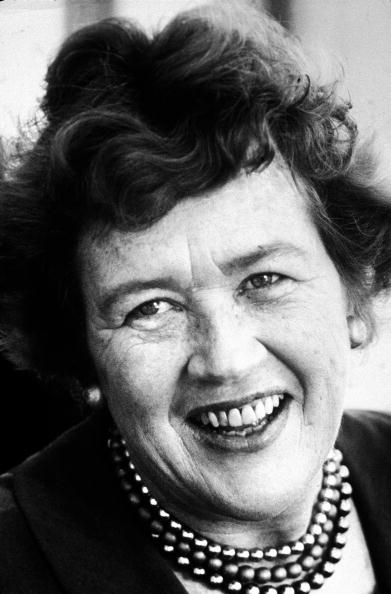
Yes, yes, you are right. That is Julia Child. As I, like many American women I am certain, immediately went out and ordered her two volume cookbooks after viewing the highly successful “Julia and Julia”. And there they sat, basically, collecting dust. Until now. For I am on the quest to make the perfect tiramisu for Christmas dinner, and that, for me, at least, begins with ladyfingers made from scratch. Julia to the rescue. Sort of.

My first task was to spend two hours searching three stores for a pastry bag, and finally surrendered to just a simple bag from Michael’s with a tip that might or might not work. (It did not.) Fortunately the accompanying literature (written on a clear plastic bag in 9 pts.) reassured me that I could use the bag simply with “the coupler”, which is used to hold the tips that do work to the bag.

Sigh. You get the picture, right? And I forged on!

Apparently, and I’m certain this is not just true for me, when you open a Julia Child recipe book you immediately invoke her spirit into the kitchen. No, really. I felt like she was there the whole time. And not in a good way. No. Sort of in a I’m-watching-every-step-you-take-to-be-sure-you-do-this-right kinda way. Yeah. So I vacillated between talking out loud to her, reassuring her I was doing my very very best, to laughing out loud belly laughs at some of her directions. Like, she measures the butter you use to oil the cookie sheet. No, really. One tablespoon. I kept wondering where it was going and then realized I’d done it when I greased the pan. Oy.

OK, so you grease two sheets with butter [so, 1/2 T each] and then flour them very lightly. Easy enough.

Oh, yes, and you also set aside 1 1/2 cups of powdered sugar, in a sieve. But I will dispute this, as I found that incredibly excessive. I probably used a third of that at most.

And now the batter. I’m going to forewarn you that if you are not really handy with baking, you will most likely find some of these steps slightly intimidating, but, in retrospect, they are not that hard, so just bless yourself and plow through. You can do it.

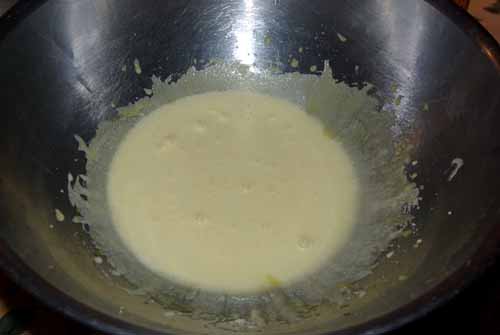
The first part is really easy. You slowly add and beat 1/2 cup of sugar to three egg yolks. Add 1 tsp. vanilla. Beat until the mixture is thick pale yellow and “forms the ribbon.” That’s what she says. Use your imagination. Here’s mine at that stage.
Part two is beating 3 egg whites and a pinch of salt until you have soft peaks. Then you sprinkle 1 T. sugar into the froth and beat until you have stiff peaks. One thing she does suggest, which I didn’t do but might in future, is to have the bowl immersed in a second bowl of ice water as you are beating. Now I’m curious and I suspect she has her reasons. Though my peaks were quite stiff, thank you.

OK, now it gets a bit trickier, but not if you have done this sort of thing before. It’s basically folding. But the language is so precise I must share. Oh, bring along 1/2 cup of unbleached flour.

Scoop one fourth of the egg whites over the top of the egg yolks and sugar mixture. Sift on one fourth of the flour, and delicately fold in until partially blended. Then add one third of the remaining egg whites, sift on one third of the remaining flour, fold until partially blended, and repeat with half of each, then the last of each.

Are you exhausted?

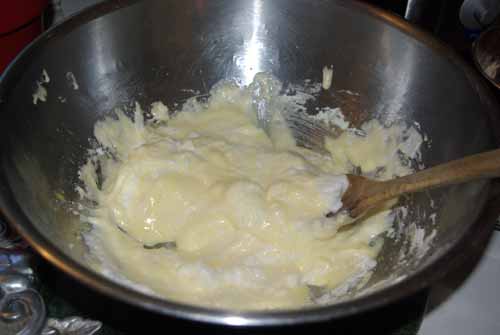
And, of course, you must not fold too much or the batter will deflate, so it’s true you must take care. It should look rather like this about half way through.
If you have worked with icing and tubes you will probably not be riled by the next step, but I have not, so I was on new territory with the pastry bag. I ran to my twitter followers after the first five minutes and tweeted, “OMG, is there a pastry bag SCHOOL???” I finally surrendered and decided it was fine if my hands were covered with batter and that the ladyfingers were clearly not “even lines” of “finger shapes 4 inches long and 1 1/2 inches wide, 1 inch apart.”
No, they were not. HOWEVER, after a few minutes in the 300F. degree oven, they seemed to rectify themselves and I was able to tweet, “It’s WORKING!!!”
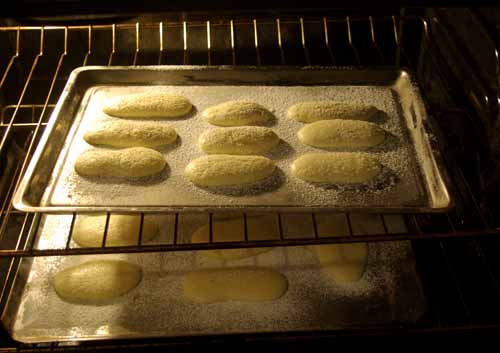
Oh, whoops. Sorry. You have to sprinkle powdered sugar on them before you put them in the oven. Julia says 1/16 an inch…

After 20 minutes or so I pulled them from the oven and put them on a wire rack to cool. I’m rather proud of myself for first effort.
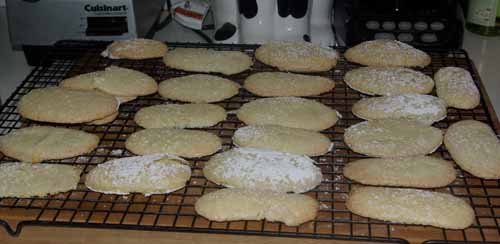
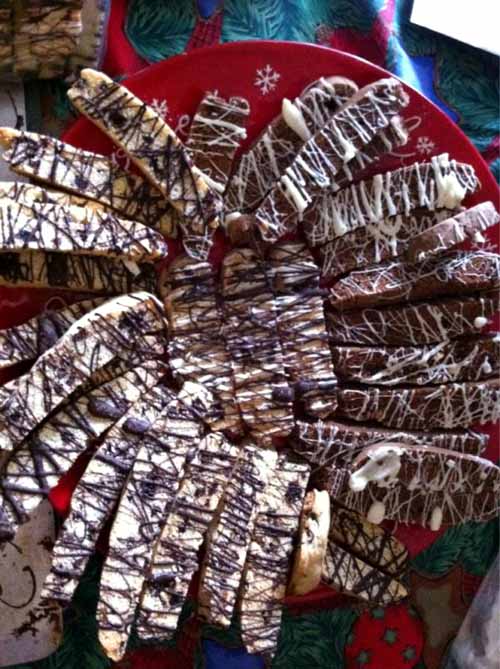
They are not “perfect” but I’m thinking that once they have soaked up some nice espresso and some Tia Maria, and are layered within their destined whipped cream, no one will be thinking of their edges. 🙂 For now they are safely ensconced in freezer bags in the freezer until I’m ready for Part Two, which I will of course post here!

Love and holiday kitchen blessings,
Kathryn xoxo
Postscript: Julia calls Ladyfingers “Biscuits a la Cuiller”.

Book Notes: Western North Carolina Woman is running an excerpt from Plant Whatever Brings You Joy in their December issue. And I’ve just learned that The English Bookshop in Amsterdam will be carrying copies of Plant Whatever Brings You Joy. Lovely! ~ And if you have not yet seen the trailer we created for Plant Whatever Brings You Joy, or you’d like to view again, click here!

Book Notes: Queen of the Sun

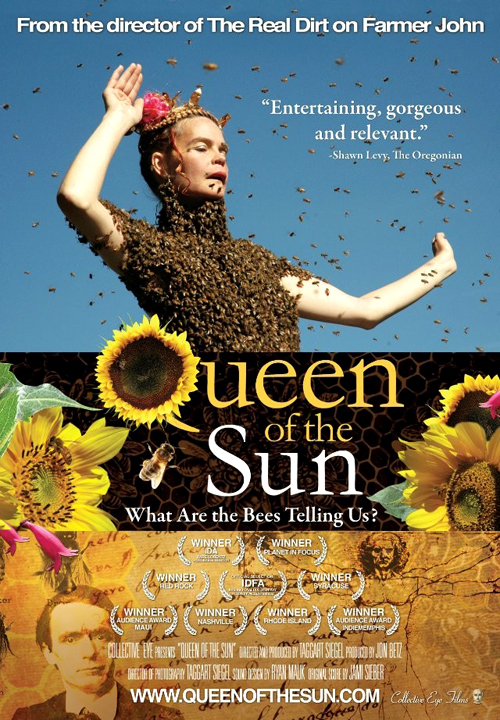
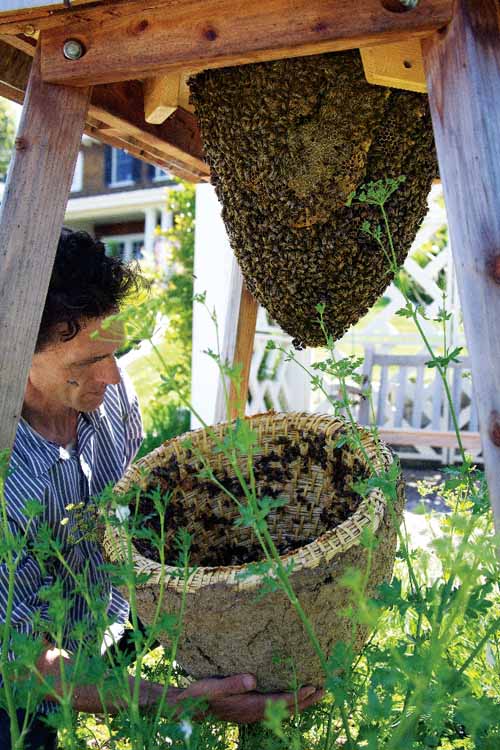
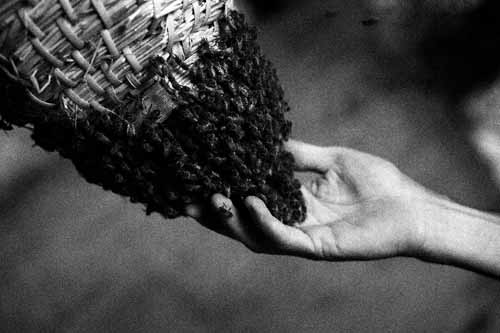
November is Bee Month, apparently, as the Universe initiates me more fully into a life that includes more bees. Anyone who has seen the image above, first introduced to us upon the release of the film “Queen of the Sun” and now, on the cover of the book Queen of the Sun from Clairview Books in the UK, is deeply moved, one way or another. Regardless of one’s insect persuasion, the mind asks, “How can this be?” And that, dearest readers, is precisely what I intend to find out. For intuitively I think I know. Else why do I cry when I see the trailer for the film?

Queen of the Sun is a wonderfully rich anthology compiled by Taggart Siegel and Jon Betz, creators of the award winning film. It serves as an excellent introduction to beekeeping, or as a guide to self-correcting if one has been educated on beekeeping by more traditional guides. Such a volume is critical if we are to save our beloved honeybees. I wept at some of the practices being currently employed. Anyone with an understanding of the wisdom inherent in the natural processes of evolution that took place over millions of years will not find it at all difficult to understand that one should NOT be moving queens into foreign hives, away from her own kin, nor should drones be regarded as superfluous to a hive, as apparently some commercial growers imagine. Can you imagine? I cannot.

Queen of the Sun abounds with lovely photos that only enhance the beauty and wisdom contained therein.


Photo courtesy of Taggart Siegel

The fourteen contributors are a collection of conscious beekeepers, poets, a molecular biologist, a philosopher, academics, artists, authors and farmers. Each brings his own loving perspective on the current state of bees and how we might begin to think more consciously about their contributions, their society, and what we might learn from them. It is a message well worth both heeding and spreading.

I personally am very drawn to the concept that to sustain bees in the most loving way possible that we, as conscious beekeepers, adhere to how bees are found in their natural state, i.e., in Nature. This causes me to feel strongly that rather than imposing the boxes we keep them in that we consider going the Extra Mile and allowing them environments that replicate their preferences. (Why is this so hard to understand?) Here’s what I’m talking about.


Photo courtesy of Amanda Lane

My whole being says YES.

Is it such a stretch to imagine that happy bees, well tended bees, bees that are loved might trust the heart that tends them?

Photo courtesy of Amanda Lane

Last night I was sleeping,
I dreamt–marvelous error!–
that I had a beehive
here inside my heart,
And the golden bees
were making white combs
and sweet honey
from my old failure.
~Antonia Machado

Bee Facts:

*To produce just one pound of honey, bees visit approximately two million flowers.
*The honey bee is the only insect that makes a food consumed by humans.
*Without pollinators most vegetative life forms would be condemned to perish.
*The hive wants drones. Unlike worker bees, drones can visit any hive. (WHY??)
*The hive cannot survive without the queen. If the queen dies, the hive dies.
*Honeybees from one colony know their mother intimately and spend most of their time in the company of their sisters.
*The story of worker bees making honey is inseparable from the story of flowering plants…Their bond is inseparable as they are entirely dependent on each other for survival.

Queen of the Sun is for thoughtful people who care about our planet Earth. It is also a doorway for exploring how we are all literally interdependent. The bees work together for the survival and well being of ALL. This is a story worth pondering.

I highly recommend this book. Please secure, read and let me know what you think and how it impacts you. Also, you might consider sponsoring the film in your local community. Go to queenofthesun.com for more information.

Love and garden blessings,
Kathryn xoxo

Book Notes: In keeping with the spirit of the times I am offering free shipping in US for all copies of Plant Whatever Brings You Joy purchased on www.estrellacatarina.com through December 25th! Please consider this gift for the gardeners in your life! Thank you!

Also, Western North Carolina Woman has kindly published an excerpt from Plant Whatever Brings You Joy in their December issue.

Book Notes: Attracting Native Pollinators

More and more I am awakening to the realization that I am destined to become a beekeeper. It is part of my spiritual path. It’s simply a matter of when and where. Meanwhile, as a kindly gentleman from Sonoma Beekeepers Association pointed out to me recently, “Start learning now.” And so I am, following my inner directives towards a path of bees, who, in all honesty, have long attended me, and I them. Along the path I was advised that the Xerces Society was about to have published Attracting Native Pollinators: Protecting North America’s Bees and Butterflies. Longtime followers of this blog would undoubtedly recognize this as My Kind of Book, so I was delighted that Storey Publishing gifted me with a copy so that I might alert all of you to Attracting Native Pollinators as a book all those interested in conscious gardening would want to have in their libraries as an invaluable resource book. For now, more than ever, it is critical that those of us who are called heed that call and learn all we can about our blessed butterflies and bees and learn to care for them, protect them from the onslaught that is their lives, and ensure that they survive, for us and for all who come after. It’s that dire, my dearest readers. It truly is.

For those of you who feel a need to educate yourselves on the current well being of pollinators in general Attracting Native Pollinators offers pragmatic information on Threats to Pollinators. I’m certain you are aware that the dreadful practices of monocultural plantings, like the almond industry, and the continued use of pesticides makes it very difficult for our wee ones. But the overall tone of Attracting Native Pollinators is in recognizing the broad spectrum of pollinators in our environments and focusing on the planting of the correct flowers for your locale, taking into account the need for host plants for butterflies as well as those that will later attract them. Chapters include Strategies to Help Pollinators, Providing Foraging Habitat, Nesting and Egg-Laying Sites for Pollinators, Pollinator Conservation on Farms as well as chapters designed for those in more urban environments.


a gentle wasp
photo credit: Rollin Coville

This book is much more than a resource on how to improve habitat for native pollinators. It is a step-by-step guide for changing our stewardship of the Earth; it is a tangible way for people of all ages to make a difference. Active participation in this vital, grass-roots revolution is easy: Plant flowers.
~Dr. Marla Spivak, from the foreword


an underwing moth
photo credit: Bryan R. Reynolds

I was particularly delighted that Attracting Native Pollinators makes clear that, generally speaking, wasps are gentle creatures. Those who have read Plant Whatever Brings You Joy will recall my story of discovering that paper wasps that had built a nest right outside my back patio door were a source of joy and discovery for me once I’d accepted that they were not the fearful critters I’d imagined.

Another section of the book I found particularly interesting were the pages on creating natural nests to attract more solitary native bees, such as leafcutter or mason bees. Check this out!

photo credit: Lloyd Crim

How to Create a Stem Bundle

Cut each stem below a node (usually indicated by a ridge) to create a handful of tubes each with one open end. Strap the tubes together into a tight bundle with wire, string or tape, making certain that the closed ends of the stems are all at the same end of the bundle.

A variation of this is to tightly pack the stems–open ends out–into a tin can, paper milk carton, square plastic bucket, or short section of PVC pipe. You could even make a wooden frame or open sided birdhouse to hold them.

They then go on to explain that you need to place the bundles in a sheltered location, stems horizontal to the ground–or slightly tilted downward–with the holes facing east to receive the warmth of the morning sun.

Do you not love this? Imagine doing this with your children or grandchildren! What an enriching memory for them. And what a teaching.

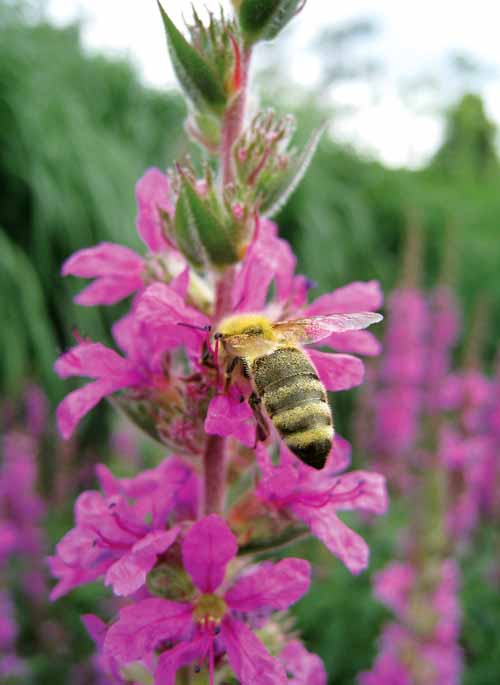
Just knowing this book was on its way to me I immediately began to look more carefully at what other insects were coming and going in my garden other than my beloved honeybees and bumblebees. I was particularly delighted to find this visitor one morning and she obliged me in staying in one lovely flower long enough for me to capture her on my camera. Anyone know what she is??

Love and garden blessings,
Kathryn xoxo

Book News! Dig It! Magazine is now featuring a wonderful review of Plant Whatever Brings You Joy.
Western North Carolina Woman is featuring an excerpt from Plant Whatever Brings You Joy in December and Ode Magazine is also running an excerpt from my book in their January/February issue!
If you have not yet visited my new book trailer on YouTube, link here!
Enjoy!
With Christmas coming I do hope some of you will consider purchasing a copy of Plant Whatever Brings You Joy for a loved one. I hear from booksellers and readers alike, “This is a beautiful gift.”

Thank you to Storey Publishing for permission to reprint their photographs.

© 2008 - 2026 Kathryn Hall. All rights reserved.
For optimal viewing Mac users using IE should access via Safari.
Pixel Surgery by Site Mechanix