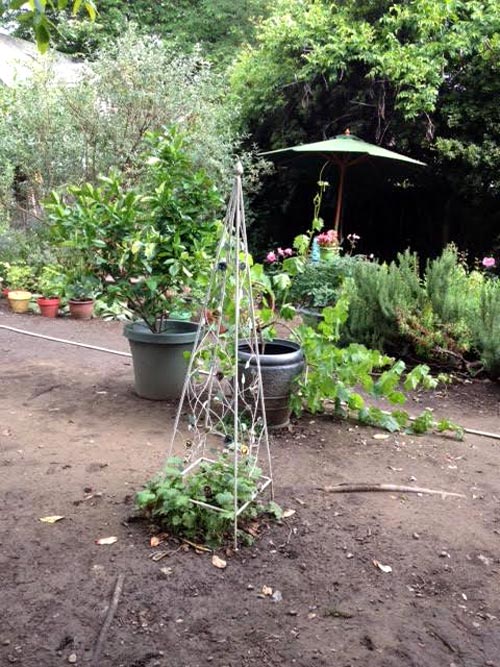
Readers of Plant Whatever Brings You Joy will be familiar with this one of the 52 lessons: “Never pull up and discard what you cannot identify,” a metaphorical invitation to not pre-judge that which enters your life that seems unfamiliar. “The Lord works in mysterious ways,” as we know. The blessings in our lives can show up in many different unexpected packages. So when I planted morning glory seeds in March on a rosy obelisk, well away from the rest of the garden, so it could not overcome whatever was growing nearby, I thought I was so clever both to get a head start, and to plant in a trouble-free spot. Imagine my surprise when what emerged were clearly not morning glories. To this day in May I am befuddled by what came up, and how, but the only “logical” explanation is that the morning glory seeds did not come up, but something that had lain dormant, waiting, did. But what? Reluctantly, I continued to water the mysterious seedlings, seeking patience, fostering curiosity, attempting to transcend my annoyance that my vision for my lovely blue flowers climbing the white obelisk was not to be. But what were they? For the longest time I didn’t have a clue. And then suddenly, out of the blue, I had a solid moment of surprised recognition. “I think those are hollyhocks!” I found myself thinking. Stunned. Incredulous. Hollyhocks? Two dozen in one spot? How could that be? I ran to the back of the garden and picked a large hollyhock leaf from my established hollyhocks, and ran back to compare. Indeed. Impossible to imagine, yet there it was. Identical. So the truth of the matter is that I planted morning glory seeds from my glass bottle of collected seeds from last year, still in their husks, some of them, and what emerged were a myriad of hollyhock seeds. Not a single morning glory seed among them.
For doubters (easy to imagine) let me assure you that I know my way around flat, round, dry, paperlike hollyhock seeds and hard dark morning glory seeds in their dry husks. No question. But there you have it. The only (near impossible) explanation is that I’d chosen a dry patch of earth away from the main garden, a place that never gets watered beyond rain, and beneath that seeming barren spot were the seeds of someone else’s long ago garden just awaiting that exact set of circumstances to take place.
There’s a metaphor in that one, dear ones, and I will let you ponder.
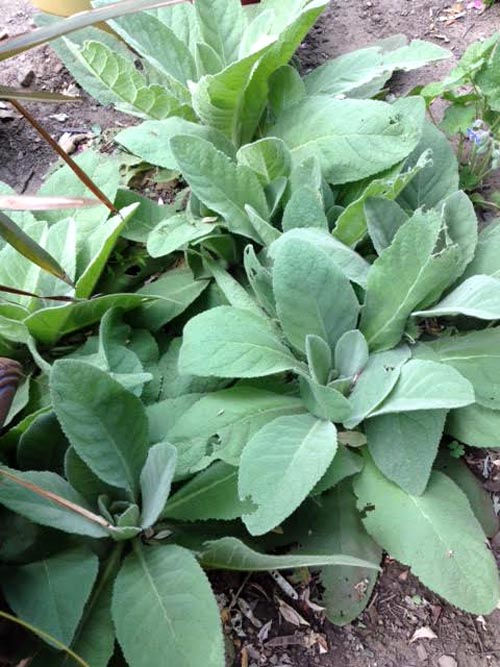
And as if that were not enough (it must be the time) I spent countless days admiring a new crop of mullein, in the exact spot where mullein had spontaneously emerged two years ago, and about which I wrote, watering it, talking to it, and wondering when it would bolt and produce some yellow flowers–which never happened, and why? One morning I looked at it and found myself saying, “You are not mullein. You are lamb’s ear.” What?? In the nine years I’ve lived on this property and tended this garden I have never seen a sprig of lamb’s ear. Not one. Nor have I planted it. Nor did it blow over the fence. No. For who knows how long, lamb’s ear has been living, invisibly, under the surface of the earth, unbeknownst to me and anyone who has ever walked My Garden, just waiting for the perfect conditions to make its beautiful self visible.
How stunning. Nine years. At the very least.
The oldest carbon-14-dated seed that has grown into a viable plant was Silene stenophylla (narrow-leafed campion), an Arctic flower native to Siberia. Radiocarbon dating has confirmed an age of 31,800 ±300 years for the seeds. In 2007, more than 600,000 frozen mature and immature seeds were found buried in 70 squirrel hibernation burrows 38 metres (125 ft) below the permafrost near the banks of the Kolyma River. Believed to have been buried by Arctic ground squirrels, the mature seeds had been damaged to prevent germination in the burrow, however, three of the immature seeds contained viable embryos. Scientists extracted the embryos and successfully germinated plants in vitro which grew, flowered and created viable seeds of their own. The shape of the flowers differed from that of modern S. stenophylla with the petals being longer and more widely spaced than modern versions of the plant. ~ Wiki
So let’s think about this, metaphorically. What beauty, what gift, what treasure lies within you, or your children, or your spouse, or your best friends, or your students, invisibly, that is awaiting the perfect conditions to make itself gloriously known, adding to the blessings that surround you? This is something impossibly close, something you are apparently oblivious to. This gift would be content to lie beneath the earth for a long long time. It has no scheduled agenda. However, with the right amount of tending, of rain, of warmth, of sunshine, it might surprise you. What would that be in your life?
I shared these stories with an elderly neighbor recently, a longtime gardener, and she said, “You know we all thought with the drought there would be no wildflowers this year. But the truth is there are more than we have seen in decades.” (She hikes. A lot.) About the hollyhocks and the lamb’s ears? “It’s the Seed Bank,” she said. Yes. The Seed Bank.
It is time, apparently, for us to suspend what we tell ourselves, what our natural expectations are, and to open to the possibility that all is not precisely what we think, how we see things. It might be different. Or better. Or unexpected. And a bigger outcome than we imagined. Better than we could have thought up for ourselves. It happens. What a miracle and blessing that the garden stands ready to remind us at any time.
Love and garden blessings,
Kathryn xoxox
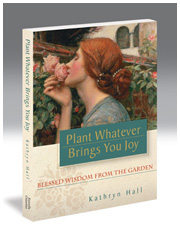
Book News: Are you a member of Goodreads? If not, it’s easy to sign up. Now through June 5th Goodreads is hosting a Book Giveaway for Plant Whatever Brings You Joy. A simple click enters you into the Giveaway! And there are ten free copies being mailed out to winners! 6/10: Congratulations to the ten winners! Books were mailed to you priority mail on Monday! Enjoy! xoxo
Goodreads Book Giveaway

Plant Whatever Brings You Joy
by Kathryn Hall
Giveaway ends June 05, 2015.
See the giveaway details
at Goodreads.
Posted on May 15th, 2015 by Kathryn
Filed under: Plants | 14 Comments »