“No wonder honey itself was thought miraculous, because each honey bee is a gram of utter miracle.” –E. Readicker-Henderson
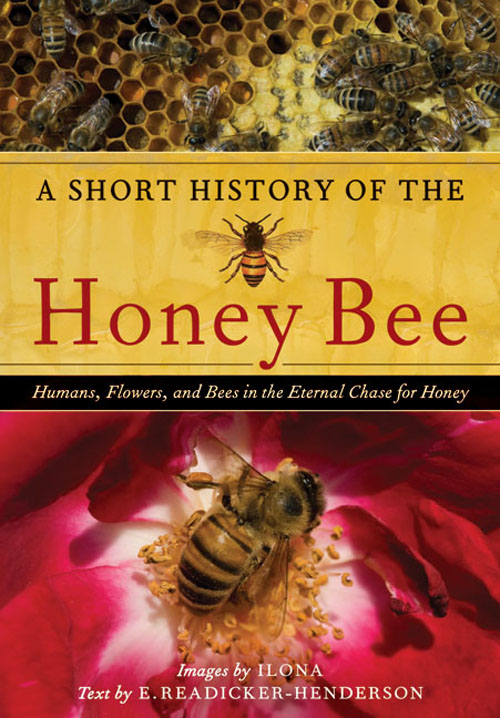
I was so thrilled to hear Timber Press was coming out with a book entitled A Short History of the Honey Bee. Sign me up! Longtime readers will know I adore honey bees, and early in the history of this blog I wrote a testy and passionate post about some current beekeeping practices and the overall well being of bees everywhere. So I was anxious to delve more deeply into a subject about which I care deeply. Lucky me. Lucky us. This book by the poetic E. Readick-Henderson and the talented photographer Ilona far exceeded my wildest expectations. I am, in short, in love with this book!
First, I must ask you, dear Readers, if you love the honey bee. Do you? In your heart of hearts? Or do you harbor some unreasonable fear from childhood not yet reframed? Here she is. (Yes, she.) Please note her little pollen pouch. So cute.
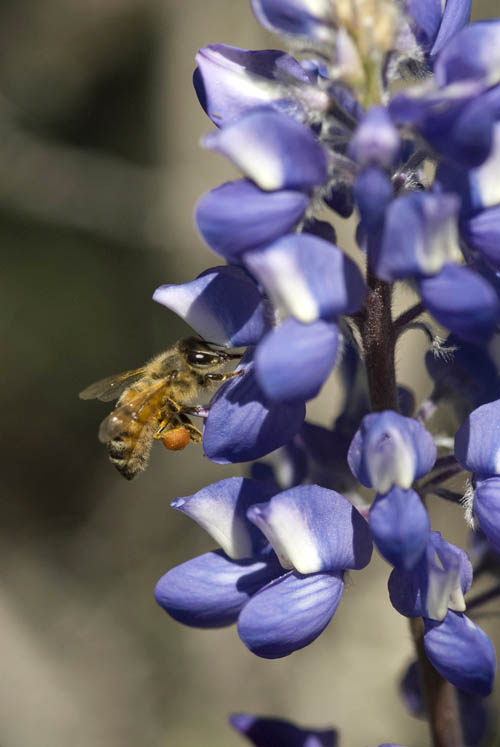
Women everywhere will relate to her. She is born, and sets to work. After three weeks in the hive conducting a very specific set of chores, she is launched into gathering, gathering, gathering. And after only a week to three weeks of this intense activity, her wings and body are so damaged from the wear and tear she simply dies of exhaustion, alone, selflessly not wanting to leave her sister bees to have to rid the hive of her spent body. Seriously. Does compassion ring in your soul?
Bee Facts
*There are an estimated 16,000 to 20,000 species of bees on planet Earth and only around seven of them make honey.
*Bees emerged over 100 million years ago, after dinosaurs and before humans, sychronistically when flowers showed up. Hmmm….
*The first bees were solitary animals. About 80 million years ago some of them began to band together.
*The first honey bees came to America in the early 17th century, when someone managed to get a hive to survive crossing the pond.
*The average honey bee flies up to sixty miles a day and will ultimately contribute one-twelfth of a teaspoon to the hive. (Gasp!)
Readers, I implore you. Buy this book. Then buy it for others. And teach your children every word. Every one. It would not be too dramatic to say that our very lives could depend on our understanding the honey bee, her role in assuring our food supply (I’m not talking about honey), and it would be one of the worst things we have ever done as human beings not to save her (and, OK, the drones). If I could I would write a huge long post trying to convey everything I learned in A Short History of the Honey Bee. Obviously it would be redundant and impossible. Just avail yourselves, please.
Here are some of the endearing images I encountered and will now cherish forever.
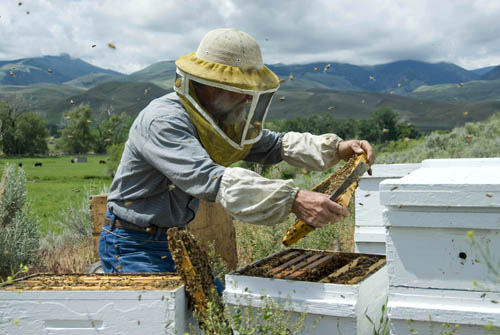
I am certain this is a really nice beekeeper as I spoke with the lovely photographer, Ilona, and she assured me the beekeepers they met in writing this book were conscientious and kind. As with so many trends in our gardener lives these days, we are truly returning and reclaiming our agricultural roots, growing and buying locally. So, too, must we consciously and lovingly begin to keep bees. Yes, you. If you are able, please explore. The author E. Readick-Henderson was lucky enough to have a father who one day brought home a hive and his son’s life was changed forever. Just as we are learning to create small vegetable gardens that make the excuse for pesticides moot, as we are able to fairly easily do our own pest control (by hand!), this return to simplicity, to small batches of everything, will ensure the return to the quality of lives we gave up when Industry came stomping through our fields and lives. The bee was no exception and quietly, these tiny generous, magnificent creatures are threatened to become extinct so busy have we been treating them like a commodity. They are one of the many gifts from the Universe (fill in your own word) and the old peoples of this Earth used to know that. Bees were regarded as sacred. Honey was immeasurably treasured. Where did we go so wrong? Love the bees. Love the bees. Love the bees.
Here’s an eye opener. Bees are wild, right? (Did you forget?) Here’s what they do if left to their own devices to build their own accomodations.
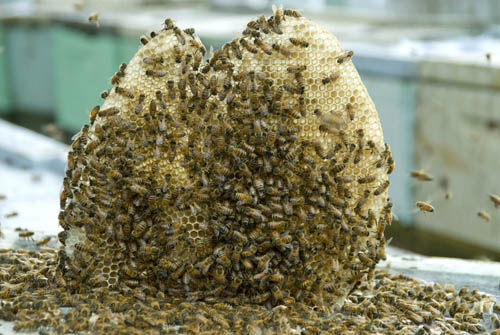
Why don’t we know this? Why were we not taught this in schools?
And here is one of the first structures ever built for bees to entice them to live nearer to us, thus alleviating the need to “line” (track) their hives, or stumble unwittingly upon them in forests. Messy.
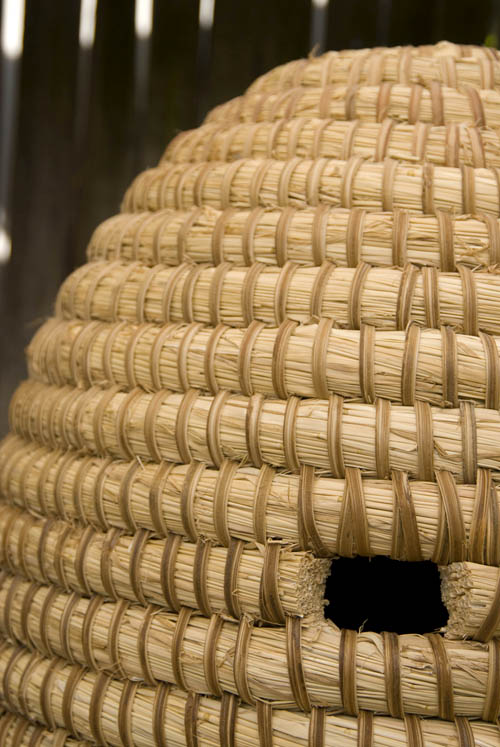
It’s called a skep. Some “undeveloped” (ha ha ha) countries still make them. Why am I guessing the bees are doing better in more rudimentary environs than in ours? The skep only lasts one season, btw. I want to make one!
Here is a wonderful photo from the book of a swarm! Have you ever seen one? I have not, and I want to learn more about them, as due to mass media hysteria (think Killer Bees) swarms are now highly misunderstood and often badly handled (as in killed). I know. This is a sad post. But I must let you know as so many of you are in a position to do something. You of all people, dear ones.
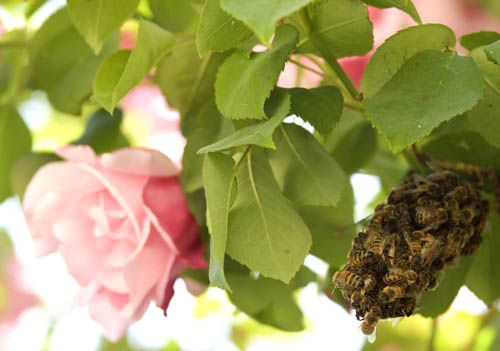
How beautiful is this search for a new home? Very.
A word about honey best comes from the mouth of E. Readicker-Henderson.
…honey is memory, the landscape’s own memory, as measured as a tree ring, as detailed as the pinfeathers of a just-fledged bird…Once you begin noticing these different tastes, colors, scents, and textures of honey, the landscape becomes more and more alive, personalized in a way previously inaccessible, like a whispered secret.
Oh, yes, dear readers. You will learn about the honey bee from a poet and an artist. What better way?
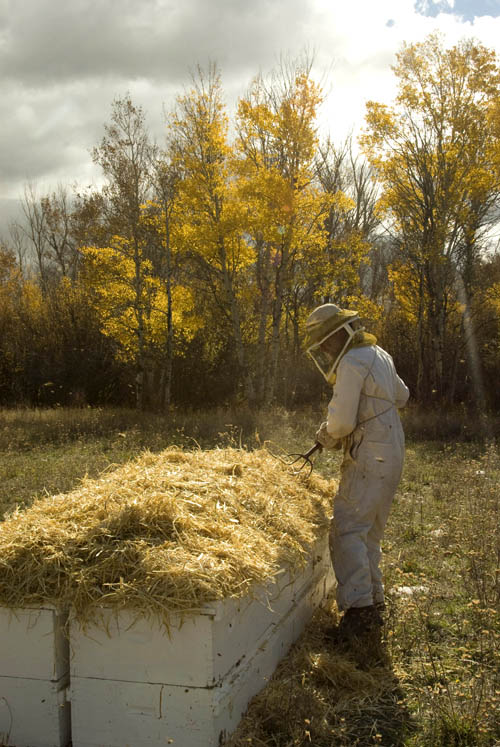
I leave you with this image of a beekeeper lovingly tending his hives, preparing them for winter. As you contemplate this lovely image, I am asking you to pray from the bottom of your hearts for all honey bees everywhere, to educate yourselves and to play some small or large part in their well being. Thank you.
Love and sweetest blessings,
Kathryn xoxo
Footnote: One of my readers read this post and sent me an article from Martha Stewart Living published last year. I was alerted to something that heretofore I had not realized: that because of the decline in beekeepers generally the (artificial) workload has been placed upon existing bees. This entails artificially rousing them from their dormancy period in order to ship them to (yet another) location to work a particular industry (almonds, etc.). Once finished they are shipped to yet another location for the next crop. Is it any wonder they have no resistance to disease? This practice is inhumane and needs to be banned. Anyone with me?
Posted on May 31st, 2009 by Kathryn
Filed under: Book Notes | 32 Comments »