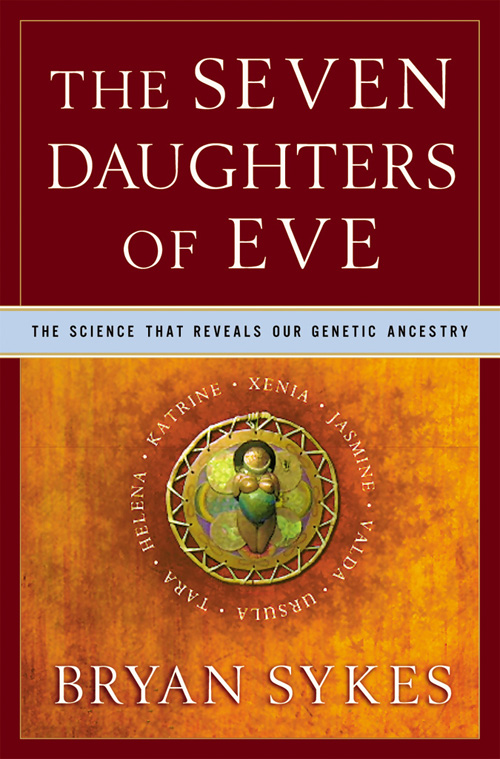
Book Notes: The Seven Daughters of Eve

Seven Daughters2

On first reflection a book review of The Seven Daughters of Eve by Oxford geneticist Bryan Sykes might seem a very unlikely choice for this particular blog. And, it’s true, I was reading the book for very different reasons, as it is an introduction to genetic ancestry from the perspective of mtDNA, the DNA component that women pass along to their sons and daughters, and that their daughters pass along to their sons and daughters, etc., ad nauseum, for, as it turns out, for many thousands of years, scarcely, if at all, changed. Usually not changed at all, which is the point. And so while the book was an excellent introduction to that bit of information there were unexpected bonus points I would never have anticipated, and those extra bits are why I know am introducing this book to you. It will not be for all of you. But it will be for many of you. Trust me on this.

First a brief on the importance of mtDNA. Since it is relatively unchanging and passed for many thousands of years through mothers–and their daughters, only–it is now recognized, as Sykes explains, a letter from the women who lived upon the Earth many thousands of years ago, to those who followed. For through Sykes’ extensive research he has been able to pinpoint that most of the folks who live in Europe today share one of seven ancestors–literally. To begin to understand it must be noted that the seven “clusters” (leading back to the seven clan mothers) had ages between 45,000 and 10,000 years.
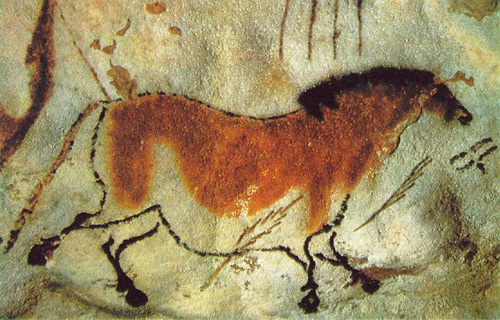
cavepainting

The clan mother is the most recent maternal ancestor that all the members of a clan have in common. Imagine a clan with ten million living members and imagine that we knew perfectly from the registry of births, marriages and deaths exactly how they are all related. ~ Bryan Sykes

These were women who lived upon the Earth many thousands of years ago, many thousands of years apart from each other. This discovery emerged after Sykes was asked to examine the skeleton of a man found by a couple trekking in Switzerland, thought to be the skeleton of a man lost in the drifts in about 1941. Imagine their surprise when they discovered the skeleton was 5,000 years old! But what is most extraordinary was that Sykes, who happened to have a large database of mtDNA on file for other scientific research, realizes that he happens to know a woman who is related to the 5,000 year old man! And thus began an extraordinary journey and study that ultimately revealed these seven women whose mtDNA was passed along over all those millenia and that could still be recognized and found very relevant today. However what made this information pertinent to me as a gardener was when Sykes begins an in-depth study on answering the question through this new took regarding an age old debate on when agrarian culture was introduced into Europe and by whom. It would be an outright spoiler for me to give you his full conclusion, however, the sheer following of his process fully captivated my imagination as I began (as you can imagine) pondering who the first gardeners were. Who were the first to stop nomadic traditions that entailed bands of human beings following the trails and patterns of wild animals in order to survive? Who was the first to recognize that it might no longer be necessary to gather berries and nuts and roots and leaves from the surrounding terrain, but took it upon themselves to begin gathering seeds instead, planting them nearby, and thus alleviating the necessity of a nomadic existence, whereupon caves were no longer used as shelter, but homes began to be built from what was available? And how and where did humans begin to travel waterways on handmade boats? I found this stunning to reflect upon, and is built upon many years of research into my own family history, ignited by knowing my ggggggggggrandfather came to Massachusetts in the 1630’s. That will do it.

So upon that long research I have begun a longer and deeper and broader look at the human journey and The Seven Daughters of Eve is a splendid introduction! As scientific a tome as this sounds you will be delighted to find eloquent passages about each of the seven women Sykes identifies through their particular pattern of mtDNA. As he is able to tie the mtDNA to specific locales and ages, he draws upon what is known through the disciplines of anthropology and archeology and spins an enchanting story for each of the seven women, whom he names Tara, Helena, Katrine, Xenia, Jasmine, Velda and Ursula. While on the surface it might seem arbitrary or superficial to have done this, I found it both poignant and pragmatic. He has given a voice and name to the actual women who lived on the Earth and who passed along their mtDNA while enveloping them in the actual circumstances in which they most likely lived. Here are a couple examples.

Ursula spent her first year being carried by her mother on the daily round of food gathering. A lot of this took place in the woods close to the spring camp. Spring itself was a lean time, for there were no fruits on the trees yet; the band relied on men to kill at least a few deer or even a bison.

Xenia was born in the wind and snow of late spring. Even though it was already April, the snow that covered the land in winter was still on all but the lowest ground and lay in thick and filthy slush around the camp site. Xenia herself was born in a round hut, about three metres in diameter, whose frame was constructed almost entirely of mammoth bones.

The Seven Daughters of Eve has touched me in a very deep way. I have opened my heart ever wider to those who came before me and carved out in the most courageous ways which I could never fully understand or appreciate a landscape in which I am able to live a life that does not entail living in a cave, needing to domesticate wolves, or going into a forest early in the morning to find food. To some this may sound farfetched. I invite you to consider otherwise by exploring Sykes incredible discoveries. I predict you will not see the world around you in the same way again.

Love and Earthly blessings,
Kathryn xoxo

Friendly Farm Animals

gabby

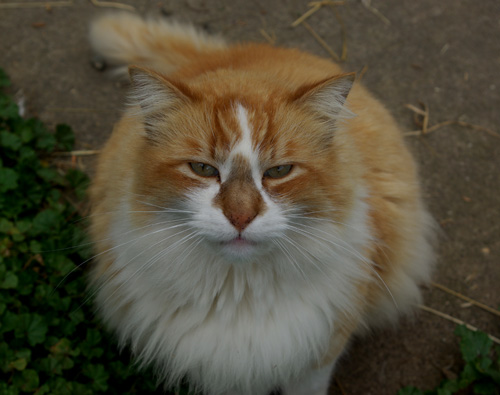
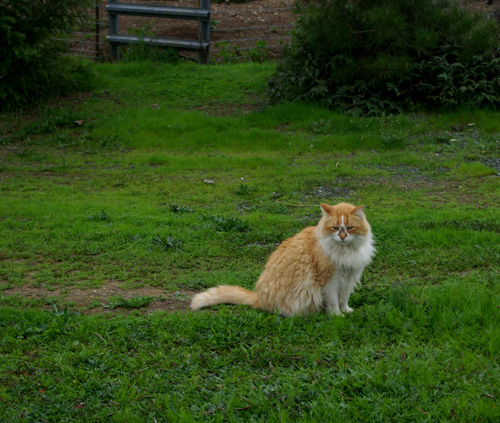
This adorable creature, aptly named Gabby, accompanied me yesterday on a delightful trek around Gabby’s pastures, where a group of friendly farm animals live under the care and guidance of a lovely woman named Dotty. (I am in love with this cat.) As we wandered about the three acres of property Gabby would meander up to each place we stopped and give her version of who I was meeting. I found this very endearing.

How I came to be at the Friendly Farm Foundation on a grey winter day was that I became intrigued with a professionally painted sign in the back window of a vehicle just in front of mine recently. So intrigued, in fact, that I followed the vehicle into a parking lot, parked and jumped out to inquire of the emerging driver to please tell me what the Friendly Farm Foundation is! Dotty kindly took the time to explain that she owns a number of farm animals she takes around to schools, fairs and nursing homes so that folks who might not otherwise have access to meeting and learning about farm animals (that would be me, actually) have the wonderful opportunity to do so. While folks are not encouraged to hold the animals, they are encouraged to pet them. This entire concept captured my heart and imagination, so yesterday I rang and arranged for the tour. Here are the enchanting animals I met.
turkey

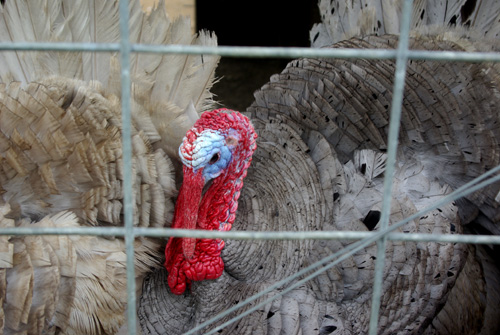
This is either Tom standing next to Tim or Tim standing next to Tom. He is a slate grey turkey, and immediately spread his tail feathers and ruffled them in my direction. “Should I be flattered?” I asked Dotty. He was cute. I had never seen a turkey with this coloration before. Have you? I’m used to wild turkeys.

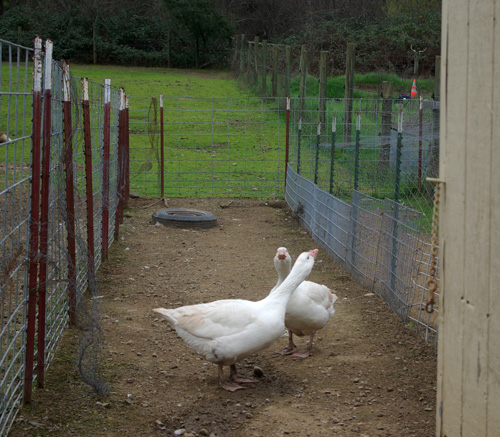
Next to the turkey cage were the Shetland geese, Amos and Andy. Lots of boys.
geese

I loved that all the animals had their own spacious living quarters, with sheds and lean-to’s to protect them from the elements. Every pen was clean and comfy.

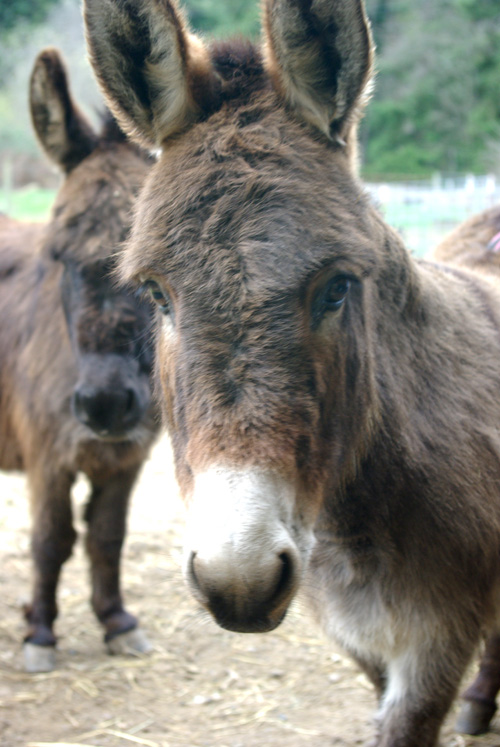
Living next to the geese were the donkeys. (Imagine the cacophony of the sounds that emanate from cage to cage!) They were curious as donkeys tend to be and I found them very sweet as well.
donkeys

Hello, sweetheart.

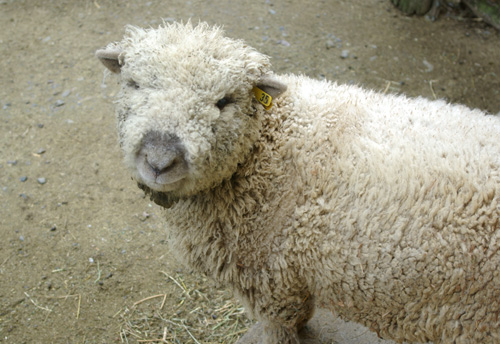
My next encounter was with this sheep, who has a face quite unlike sheep I’ve met before. He reminded me of a koala bear. Don’t you think?
sheep

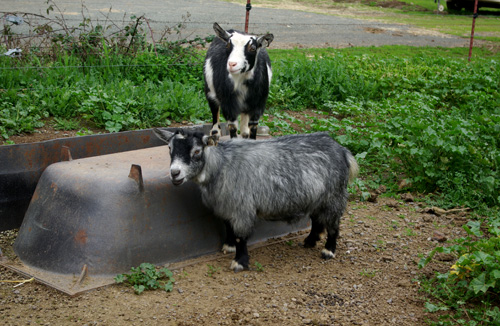
Just beyond the sheep, who apparently had been “playing with the chickens” just prior to my arrival–wish I’d seen that!–were the pygmy goats!
goats

Surprise, surprise! They are both pregnant. It takes five months for a goat to come to full term. Wow. All the goats I’ve met in the past were rather nosey. But this pair of friends were very respectful of my space as I was of theirs, even though I did enter their pen, once Dotty had reassured me they would not be butting or nosing me. Dotty clearly has carefully chosen the animals she introduces to the public.

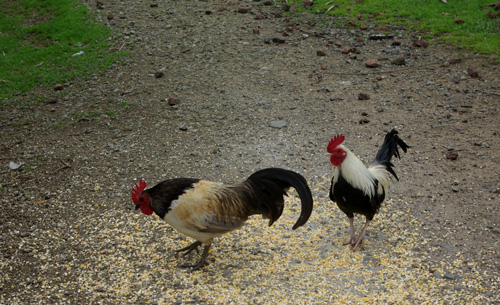
We made our way through a large area that housed many kinds of hens and roosters. (Five roosters!) Rest assured I inquired whether any of the roosters were aggressive, not being naive to that possibility, but true to her word, all the roosters graciously allowed me to pass through unmolested. I was charmed to see a small grey hen moving quickly under the bushes with a tiny posse of babies trailing behind her, following her into the thicket, safely out of sight. These guys all made it into the lens of my camera, however.
2hens

These chickens remind me of some old Renaissance painting. Aren’t they beautiful?
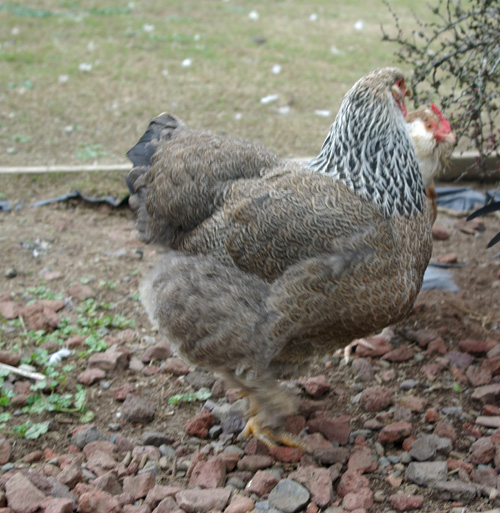
lacyhen

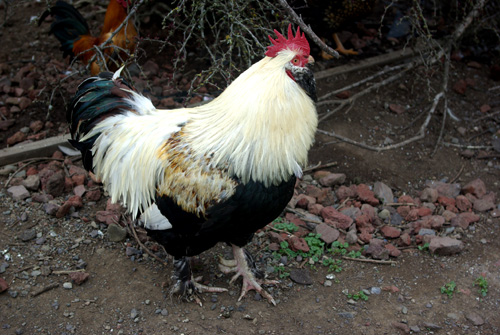
This hen captured my attention for the intricate designs in her muted feathers. I’ve never seen a hen who looked like this before.

And look at this stunning fellow, a Black Brahma!
whtrooster

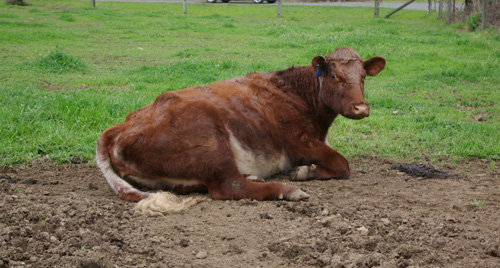
On the far side of the chicken yard was a large pen housing two very large cows. I was told they are Pinzgauers, which is a new name to me. They were both very imposing, but docile. This one is (strangely) named Shorty, and I learned that she, too, is very pregnant!
shorty

Dotty, who has been raising farm animals her entire life, informed me that she has helped deliver hundreds of sheep and cows and goats. I’m trying to imagine what my life would seem like if I had that under my belt. She is one of the earthy, practical, amazing women who can midwife birth, even difficult births. I am in awe of such women.

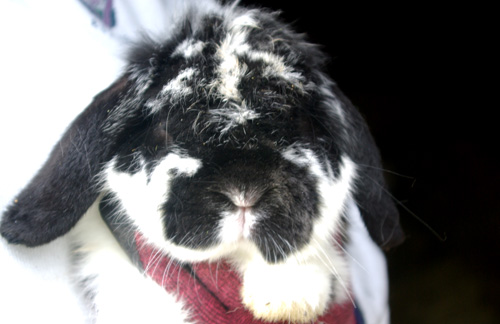
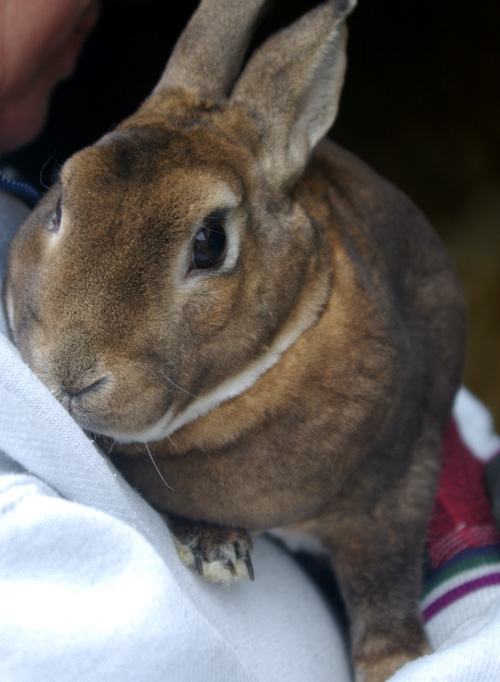
Rounding out the tour we passed back through the barn where two lovely soft rabbits live, named Bunny Foo, a mini-Rex and Boscoe Bunny, a mini-Lop. Here they are.
lop
bunny1

This is the softest animal I have ever touched in my whole life. Delicious experience!

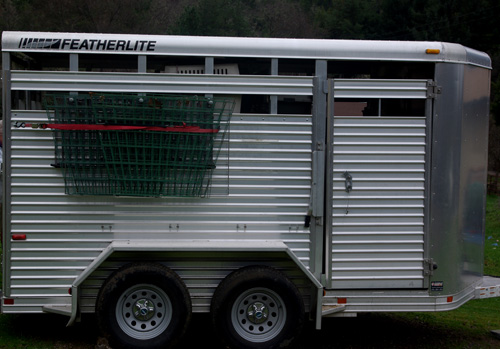
As we stepped outside the barn Dotty introduced me to the trailer into which all these animals get loaded up to make their trips out into the world, introducing people of all ages to the lovelihood that is all things animal. Quite amazing, actually. I am curious and fascinated that the destiny of this particular group of animals is to bring joy and comfort to people. Domestication is a long road I do not take for granted.
truck
gabby2

Ending my tour where I began, I bade farewell to the companionable dear Gabby and her Mommie, the very hospitable Dotty. Thank you so very much for the most delightful winter day!

Love and animal blessings,
Kathryn xoxoxo

And the Winner Is!

valentine
This winter I introduced the idea of a Brownie Recipe Contest, the winner receiving a copy of a Chronicle Books recipe book I was reviewing, Luscious Chocolate Desserts. Many thanks to those of you who submitted recipes, which were far more varied than I could have imagined. A cousin sent one in with cayenne in the listed ingredients, and I subsequently learned it’s not an uncommon pairing, chocolate and cayenne, relished by some! So I learned some things! For example, I’ve honestly never let a recipe dictate that the size indicated is the size I must have, priding myself on finding alternatives if necessary, but apparently with brownies it does make a difference. Fussy things afterall, in spite of seeming to “easy.” I also learned that the doubleboiler is apparently becoming a thing of the past. Who knew? I actually drove an hour to Macy’s to get a proper one, and they “don’t sell them anymore.” (How could this be?)

Toward the end of the clarion call for recipes, a local amazing artist named Linda at the highly creative blog Vulture Peak Muse squeezed in with the following endearing comment:

ok ok ok, this is THE story of my life-being late! but if you are still looking and baking and testing and gaining weight, here you go with another one and this one will beat all of the rest! Just try it and see if you don’t agree and it’s as easy as can be…

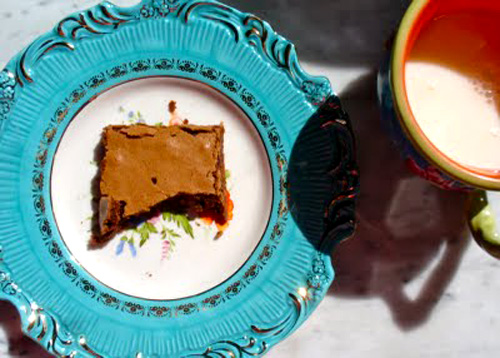
So I added her recipe to the growing number. And today, day after Valentine’s Day I am happy to announce Linda as the WINNER of the Best Brownie Recipe Contest! Congratulations, Linda! Here is her recipe:

I changed this recipe over so many years of making them, I have no idea of it’s origination nor it’s many trials, errors, additions nor alterations. I don’t know where it originally came from but possibly many recipes rolled into one. You probably know what I mean!

This is the easiest and quickest, as well as the most delicious brownie recipe you will ever try. Trust me. Try it and see if I am not telling you the absolute truth about brownies! My recipe card’s well worn appearance is evidence of how much we have made our brownies over the years. I taught my oldest son, Brian, to make them by himself and wrote it so he could read my writing, thus the black Sharpie pen that would NEVER go away!!! 🙂

This recipe was published in the Tomales Kindergarten Cookbook of 1981, along with Great Grandma’s Apple Cake and Mom’s Lemon Bars~

lindasbrownie
~Brian’s Brownies~

4 oz. Scharffenberger or other sinfully delicious AND healthy {and expensive} semi-sweet or bittersweet chocolate
1 whole cube and one half more cube of unsalted butter ~
plus generous amount to grease the 9×13 glass {pyrex} baking dish

Melt slowly in large heavy pot.
Remove from heat and add to pot:

2c sugar
4 well beaten eggs
1T very very very good vanilla {Ina impersonation}
Mix this well by hand, beating a few minutes.

Add:
1 1/4c flour
1t baking powder
1t salt

Stir well and pour into prepared pan.
Bake @ 350degrees for 23 minutes
{ toothpick will be wet but with some bits of crumb beginning to form~
the hardest part of brownie baking is knowing when to remove the pan.}
~~~~~

What you see before you, my friend, is the result of a lifetime of chocolate.
~Katherine Hepburn~

Editor’s notes (that would be me!): I tweaked this recipe in a couple of minor places: My brownies needed a bit more time than 23 min. And I made a point of whisking the flour, salt and baking powder prior to adding to chocolate mix; and some little part of me said to sift the flour as I was adding, so I did.

Thank you, and many blessings, Linda! Absolutely delicious recipe! And I loved the simplicity of making in one heavy pan. I will get a copy of Luscious Chocolate Desserts to you soon!

Valentine’s hugs and kisses,
Kathryn xoxoo

© 2008 - 2026 Kathryn Hall. All rights reserved.
For optimal viewing Mac users using IE should access via Safari.
Pixel Surgery by Site Mechanix