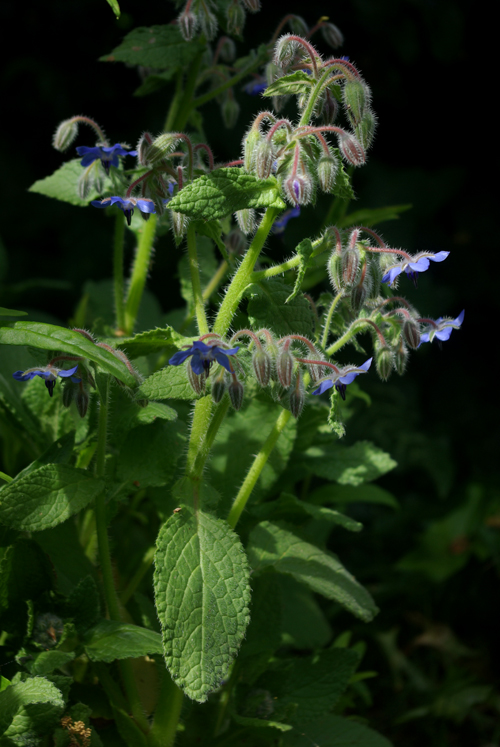
Borage
Honestly? Prior to moving here I had never heard of an herb called borage. I found it in abundance in the kitchen garden and had to inquire about what it was. To this day I call it BOR-age, as if were two clear syllables. And French. I have since learned that herbalists (around here, anyway) pronounce BOR-age to rhyme with porridge. In any case its Botanical name is Borago officinalis. It was thought by some to originate centuries ago in Assyria. It has made its way to several continents, and no wonder. This is a strong, vital plant none too fussy about the soil in which it grows, in no immediate danger of extinction. It keeps itself going quite well, self sowing, with very little assistance. Women have been using it in their kitchens since ancient times. These are the plants that intrigue me the most.
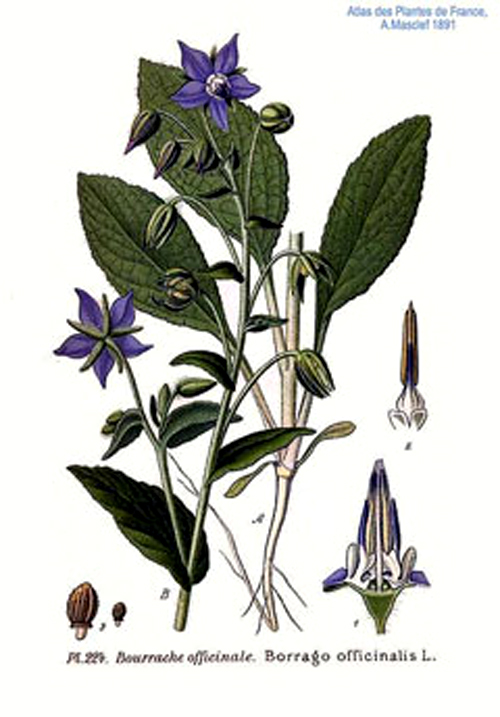
Gerard says:
‘Pliny calls it Euphrosinum, because it maketh a man merry and joyfull: which thing also the old verse concerning Borage doth testifie:
Ego Borago – (I, Borage)
Gaudia semper ago. – (Bring alwaies courage.)
Those of our time do use the flowers in sallads to exhilerate and make the mind glad. There be also many things made of these used everywhere for the comfort of the heart, for the driving away of sorrow and increasing the joy of the minde. The leaves and floures of Borage put into wine make men and women glad and merry and drive away all sadnesse, dulnesse and melancholy, as Dios corides and Pliny affirme. Syrup made of the floures of Borage comforteth the heart, purgeth melancholy and quieteth the phrenticke and lunaticke person. The leaves eaten raw ingender good bloud, especially in those that have been lately sicke.’According to Dioscorides and Pliny, Borage was the famous Nepenthe of Homer, which when drunk steeped in wine, brought absolute forgetfulness.
John Evelyn, writing at the close of the seventeenth century tells us: ‘Sprigs of Borage are of known virtue to revive the hypochrondriac and cheer the hard student.’
~A Modern Herbal by Maud Grieve
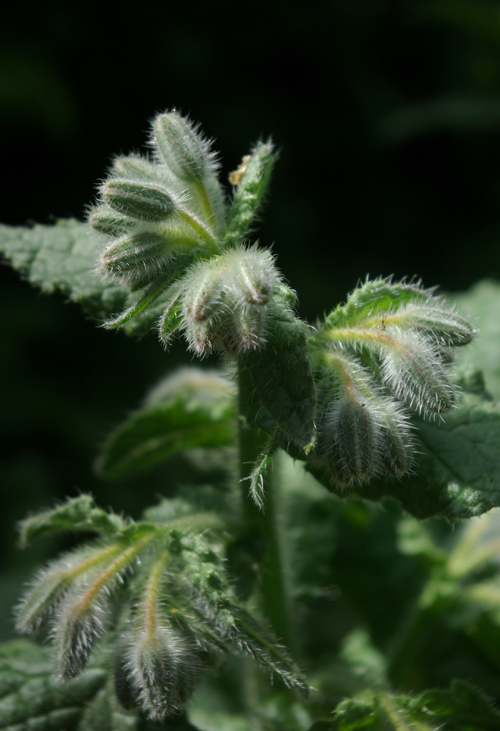
Borage buds
I gave a cursory research a couple of years ago of borage and it was enough for me at the time to discover that women used to put a flower in each ice cube they made which fascinated me so that I immediately did it. It was fun, but I must confess that guests whom I served some summer drink with borage flowers in their ice cubes were suspect. And isn’t that the way with new things, especially plants in the garden ending up in our salads and drinks? Further research, however, shows that borage is very commonly associated with refreshing drinks, both the leaves and the flowers. They are continually described as similar to cucumber and as a refreshing additive to both water and wines. It is said that the English used to include it in Pimms. I’m thinking that a bottle of ice water with borage leaves or flowers would be a nice addition to summer days.
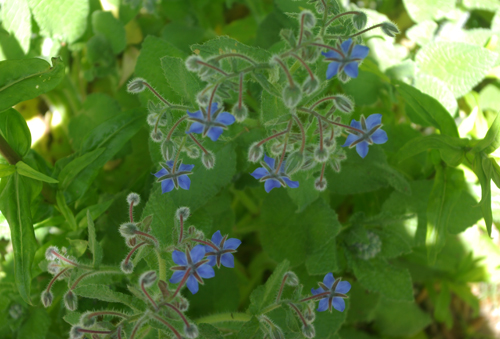
Borage leaves, when young, are also traditionally cut and used in salads or stir-fried, much as you would spinach. You can even include with spinach. Two words of warning, however. Borage, while nourishing, is not to be eaten in abundance, as it contains a very mild toxin you would not want to overly ingest, particularly if you have liver problems. I have just spoken with a local respected herbalist, Donna d’Terra, who says, “It’s always good to err on the side of caution.” She does not recommend borage for the very young, very elderly or pregnant women. She points out that when the plant is just emerging it is most likely to have the alkaloid in question, as a kind of self-protection to avoid foraging animals, therefore if one waits until the leaves are a bit larger–say larger than the size of your hand, she says, this alkaloid will be less in abundance. She also says the plant will be better for consumption if it is not stressed, say from lack of water. Fascinating! Please note that if you are to include leaves in your kitchen be sure to pick prior to being very mature leaves, which bear white hairs that will irritate your skin upon touch.
A noteworthy fact about borage is that it has been used traditionally as a companion plant to tomatoes, cucumbers and strawberries! There are those who are certain it discourages tomato worms. These old traditions often strike a cord within me, a cord that says, yes, this is right. Let’s try this.
Those who nourish borage in their gardens will also find an abundance of bees of all descriptions, upon which borage is dependent to be pollinated. As it is longlasting your bee visitors will also be about frequently. This alone makes the growing of borage worthwhile, to make a bee happy. While I have not tried honey made from borage I’m assured it is delicious!
Another lost art is to candy the borage flowers! Here’s a recipe. I’m imagining this would be a lovely thing to do with one’s grandchildren this summer. So easy! So charming! And they will never forget.

To Candy Borage Flowers
Pick the borage flowers, each with a small stem, when they are quite dry. Paint each one with lightly beaten egg white, using a watercolour paintbrush. Dust them lightly with superfine sugar [in Britain one would use castor sugar] and set to dry on waxed paper in a warm place like an airing cupboard or in a very cool oven.
Love and kitchen garden blessings,
Kathryn xoxox
Footnote: In response to Julie’s question re: proportions I’ve done a bit more research and following a recommended lead from California School of Herbal Studies comes this:
Borage Flower Tea: handful of fresh leaves steeped in 1-2 quarts of water, add one or two sprigs of spearmint. Makes a refreshing summer beverage. More here.
Book News: Recently visited Gallery Bookshop in the village of Mendocino and was delighted to find my book face out just underneath one of Julia Cameron’s books, in the Inspiration section. Kinda teary, touched and very grateful.

Posted on May 2nd, 2012 by Kathryn
Filed under: Plants | 17 Comments »