Boston Brown Bread!

New England is in my blood, even as I identify myself very much a California Woman. George Hall, my paternal gggggggggrandfather arrived in Massachusetts shores in the 1630’s! As a teen I attended high school in Massachusetts, spending summers in Maine. During this time I absorbed a bit of New England culture. Along with beef stews full of carrots and onions and potatoes there was brown bread, which, when my daughter Antonia was a wee little girl, I taught myself to make. Who knows what moved me to dig out that recipe and make a batch after so many years? But I did, and here I share with you, as it’s ever so easy to make and a delightful addition to your repertoire!

Here’s what you need to get started:

Ingredients for making Boston Brown Bread
1 cup wholewheat flour
1 cup rye flour
1 cup finely ground cornmeal
1 t. salt
1 t. baking soda

3/4 cup molasses
1 cup raisins
2 cups buttermilk

Simple directions:

Mix in a medium size bowl the dry ingredients listed above.
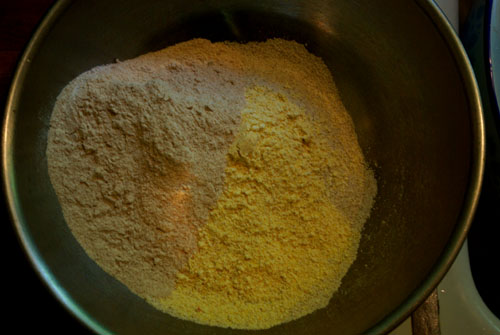
flours

In a larger bowl whisk together the second group of ingredients above. I used a combination of dark and golden raisins.
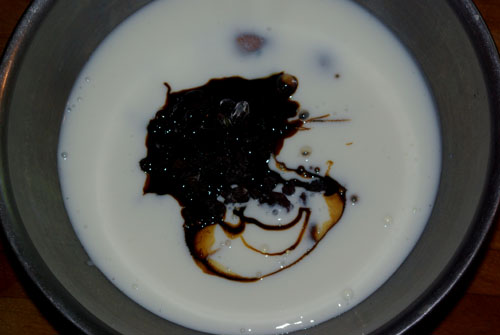
liquid

Add wet mix to dry.

mix

This is the unexpected part, for rather than placing the batter into a traditional pan, you need to fill several metal cans, which you have greased with butter, 2/3 full. For this recipe I chose to use four cans that had contained organic pumpkin (which I feed to my dogs). I specifically chose these cans as they did not have BPA liners. Were you to look for alternative recipes you would also see that some folks use empty metal coffee cans. I don’t drink coffee, so that would not be an option. These worked perfectly. So here they are, ready for the next step.
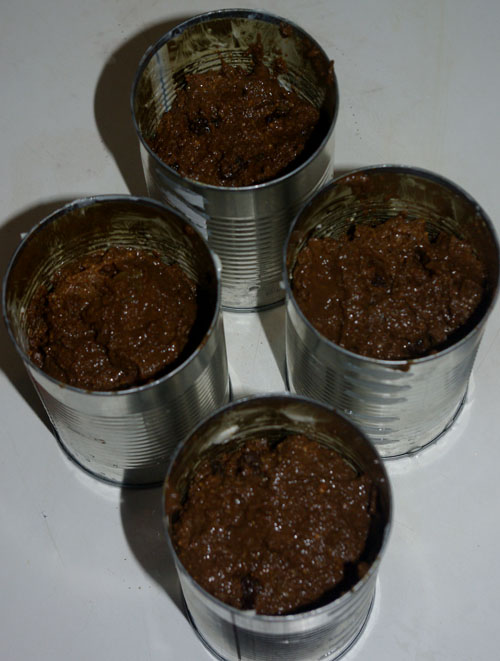
ready

Now. The next step will seem unlikely, but follow along! You need to place a piece of aluminum foil over the top of each can, and tie down the foil with twine. Two notes: the side of the foil which faces the batter you want to also grease with butter. And I doubled the foil prior to placing over top of can.

And then you place the covered cans in a heavy kettle of water. Water level should reach half way up the cans. Cover.
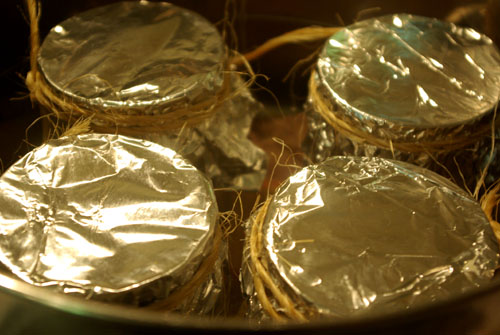
pot

Bring the water to a shallow boil and reduce the heat sufficiently that the water is simply simmering. You will need to allow this simmering for two hours. Be sure to check water level so it does not evaporate below the half way mark. And be sure, also, to check the heat level so the simmering is gentle.

When the two hours are up, remove cans from the water, remove the foil, and place cans on a board or counter to cool.
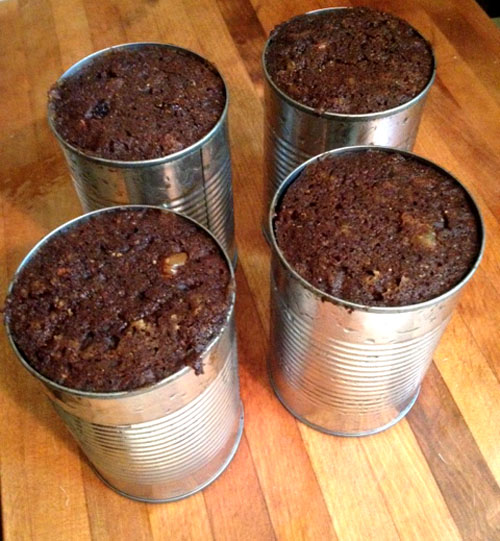
cans
Once cooled, run a knife around inside edge and the bread will readily slip out of the can.
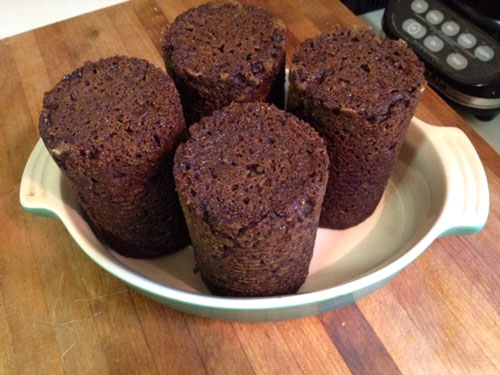
out

Boston Brown Bread is traditionally associated with hot dogs and baked beans, which is a lovely way to serve. But don’t hesitate to simply put a bit of butter on top and serve for breakfast or tea. Or try a delicious bit of cream cheese as well. I particularly appreciate that it is iron rich with molasses! Note: To store, I place in a plastic bag and refrigerate. As I want to serve, I slice off what I need, and steam prior to serving. I think you will find it deliciously yummy and a family favorite!
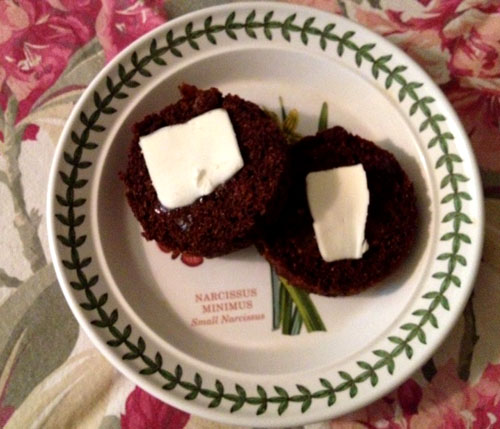
done
Love and kitchen blessings,
Kathryn xoxo

Book News: This week I received notice that this blog was included on a list of Top Twenty Gardening Blogs of 2013. A complete list can be found here. I’m also very much looking forward to an upcoming interview. On June 23rd at 8:30AM (PDT) I will be a guest on the gardening show “Bob Tanem in the Garden” on KSFO in San Francisco!

Shopping Bags, Part Two

Hello, dear readers,

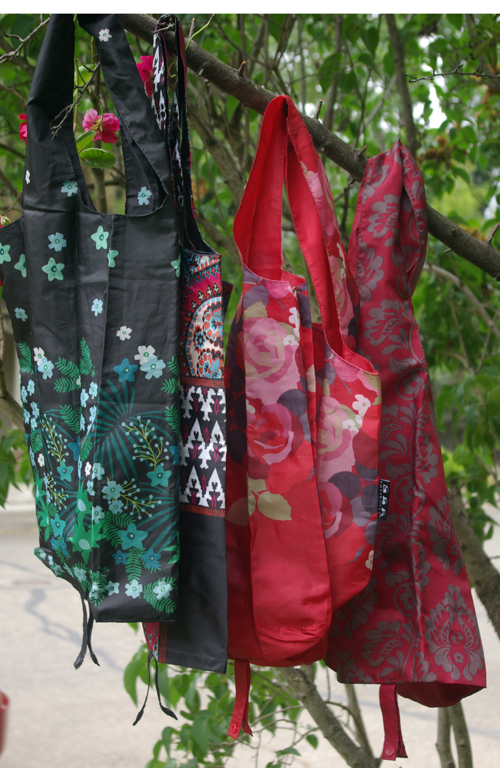
Way back in 2009 I did a quite thorough post about bags, meaning the ones we carry to the market or to stores to bring our purchases home in, so as to be very responsible in helping to reduce plastic bags and paper bags use. At that time I was not in the habit of always bringing bags along, and I knew that if I did a post about bags, and researched consciously my choices, I would find the best solution for my own needs. And I thought I had. At that time I concluded I would be most likely to use the big ones that have a flat bottom and handles on top. But, in fact, I ended up using the ones I could pop into my purse and have at the ready anytime needed. I found them less bulky and much easier to actually have with me at any given time. And I do that now, meticulously. They are inexpensive. They are colorful. They wash readily. The only thing I have to do to maintain the practice is to take the time to roll them back up and snap them in place so they are tucked into my purse at the bottom, not getting in the way. The ones I’m currently using look like this:

openbags

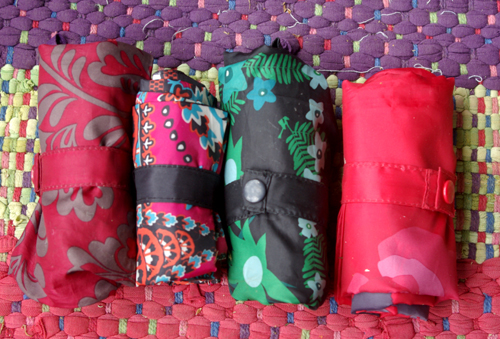
And when they are properly rolled up, they condense down to this:

bagsclosed

Handy, right? And I always have them at the ready. And they carry a lot.

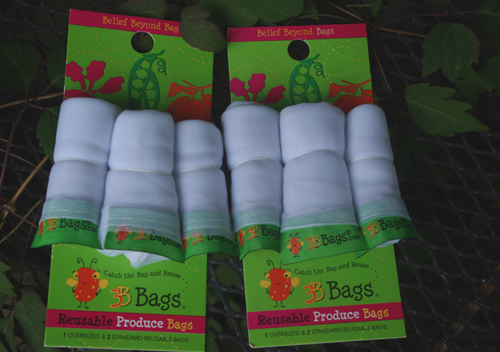
But I did have a hole in my routine, as I was still grabbing plastic bags for individual vegetable and fruit purchases. There are those in this community who pop them unwrapped into their shopping baskets but I must be too fastidious to do this. I start thinking of where those carts have been and what they have been carrying. Eeeuuu. And then a marvelous thing happened. A woman behind me in line at the health food store laid out a few sheer white bags full of vegetables on the counter and I said, “Oh, wow. Where did you get those?” And as convenient fate would have it, they were for sale in a display near the door! So I grabbed a few. This is what they look like rolled up:

whiteclosed

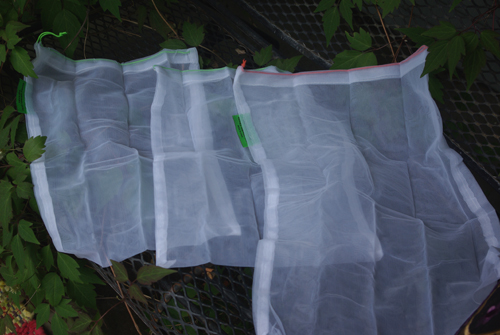
And here is what they look like ready for use:

whiteopen

Aren’t they wonderful?? I am so happy to have this solution to that particular ecological need. The packaging says, “Reuse once a week. Reduce as many as 150 plastic bags a year!” I can easily imagine that is true! They are called 3bbags. I’m sure you can google them.

I’d love to hear what solutions you have found to reduce your consumption of plastic and paper bags, and I hope this post inspires you to add another layer, as I just did!

Kitchen blessings,
Kathryn xoxoxo

Book News: On Sunday morning I was the guest of Lillian Brummet on “Conscious Discussions”, a radio show out of British Columbia. Link here. A review of Plant Whatever Brings You Joy was featured on The Ripple Revolution blog! And on Friday I’m looking forward to doing an Author Meet and Greet at 2:00PM at Copperfield’s Books in Healdsburg in Sonoma County! I hope some of you might stop by!

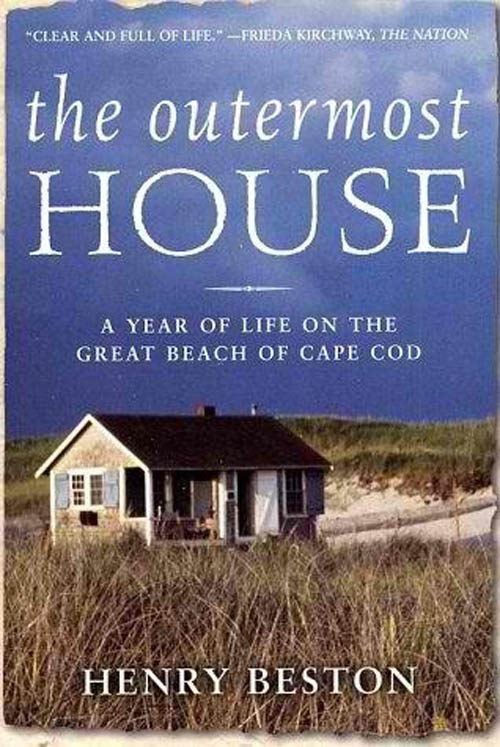
Book Notes: The Outermost House by Henry Beston

Bestoncover

A recent trip to the vet on behalf of one of my kitties found me waiting in what serves as the acupuncture room. Quietly awaiting I began to explore the room. A framed quote caught my eye and as it was mounted quite high, I pulled it off the wall to read more carefully. Here is what it said:

We need another and a wiser and perhaps a more mystical concept of animals. Remote from universal nature, and living by complicated artifice, man in civilization surveys the creature through the glass of his knowledge and sees thereby a feather magnified and the whole image in distortion. We patronize them for their incompleteness, for their tragic fate of having taken form so far below ourselves. And therein we err, and greatly err. For the animal shall not be measured by man. In a world older and more complete than ours they move finished and complete, gifted with extensions of the senses we have lost or never attained, living by voices we shall never hear. They are not brethren, they are not underlings; they are other nations, caught with ourselves in the net of life and time, fellow prisoners of the splendour and travail of the earth.

I was deeply moved, as this quote resonated with the deepest part of my being and I have many times tried to vocalize some of these same thoughts, but never so eloquently! But who wrote it? There was no author attributed. When I arrived home I typed in a portion of the quote and thus began my introduction to Henry Beston, the author of The Outermost House: A Year of Life on the Great Beach of Cape Cod, which I promptly ordered. There is a synchronicity to this finding, as I’ve been thinking a lot about the Cape these last few months. I have a very old friend, a former teacher I met when I was doing my student teaching in college in Ohio, who has lived on the Cape for years. She took me there once, all the way out to Provincetown. I think once one has been to the Cape it is not forgotten.
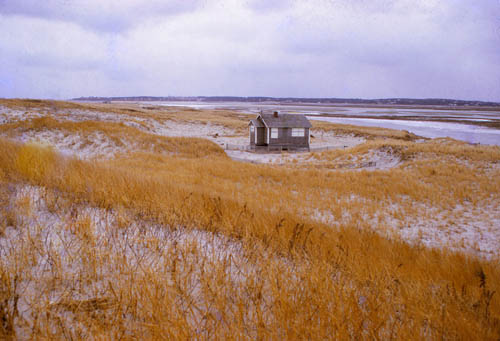
Apparently this is what happened to Henry Beston, who, in 1926, after having someone build him a small house on the Cape where he might on occasion visit, he writes, “I went there to spend a fortnight in September. The fortnight ending, I lingered on, and as the year lengthened into autumn, the beauty and mystery of this earth and outer sea so possessed and held me that I could not go.”

Bestonhouse

Henry subsequently spends a year on the Cape in his small, but comfortable home, documenting, as a naturalist, all the things he bears witness to on those dunes, at the sea’s edge. His adventure closes and he becomes engaged and his future wife tells him she will marry him only when the book is done. 🙂

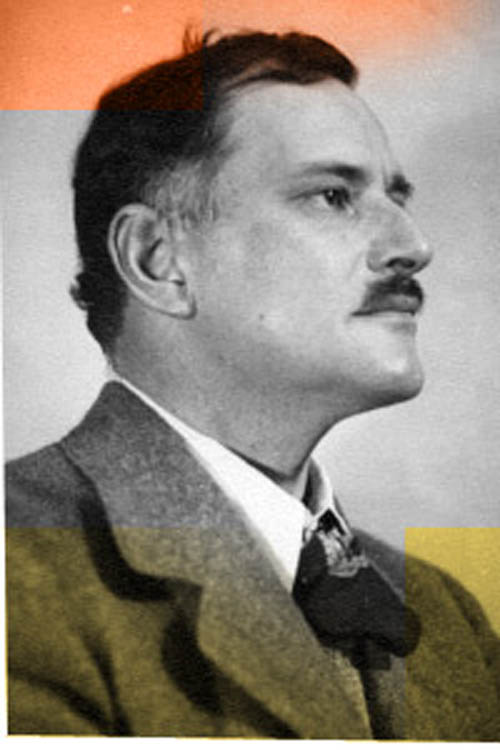
It would be easy and natural to compare Beston to Thoreau, and while one might call them kindred spirits, Beston is a very different kind of man and writer.
Beston

His writing is authentic and speaks to issues of our day without the political layers intrinsic to Thoreau, thus, perhaps, capturing a different, and maybe even a wider audience. The copy I secured is stamped as the “75th Anniversary Edition”. I’m happy to bring his work to the attention of my readers. I’m certain many will find nurturance in Beston’s writings.

Touch the earth, love the earth, her plains, her valleys, her hills, and her seas; rest your spirit in her solitary places. For the gifts of life are the earth’s and they are given to all, and they are the songs of birds at daybreak, Orion and the Bear, and the dawn seen over the ocean from the beach.

When the Pleiades and the wind in the grass are no longer a part of the human spirit, a part of very flesh and bone, man becomes, as it were a kind of cosmic outlaw, having neither the completeness and integrity of the animal nor the birthright of a true humanity.

Happy reading!

Love and spring blessings,
Kathryn xoxo

Footnote: Some of you will find it interesting that Beston’s outermost house was proclaimed a National Literary Landmark in 1964, however it was unfortunately destroyed in a massive winter storm in 1978.

© 2008 - 2026 Kathryn Hall. All rights reserved.
For optimal viewing Mac users using IE should access via Safari.
Pixel Surgery by Site Mechanix