Dia de los Muertos

Will I have to go alone
like the flowers that perish?
Will nothing remain of my name?
Nothing of my fame here on earth?
At least my flowers, at least my songs!

Ayocuan Cuetzpaltzin, 15th C. Aztec poet

As our days shorten, and our nights lengthen, the energies of our garden
recede for winter and our thoughts begin turning inward. Our upcoming holidays are very much in keeping with this shift in energies. Halloween, originally called Hallowe’en, or Holy Evening, is a holiday with cross-cultural roots. A closely related Hispanic holiday celebrated at nearly the same time is Day of the Dead, or Dia de los Muertos.

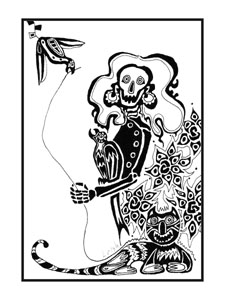
Jardin perico

[Jardin Perico, compliments of Carolyn Leigh.]

Dia de los Muertos is a special time in the lives of our Hispanic neighbors when they honor their ancestors by embracing and celebrating those in their families who have passed. They build altars to honor their dearly departed and, as a tribute, prepare their ancestors’ favorite foods. Upon their altars they place candles, the favored foods, and ropes of marigolds, which they view as a symbol of death. I must confess that I learned about these marigold ropes by once returning to a Mexican hotel after a trip to the local market gaily sporting one around my neck and someone discreetly informed me what they were for. So much for understanding local customs. No matter. Lesson learned, and I took it to heart.

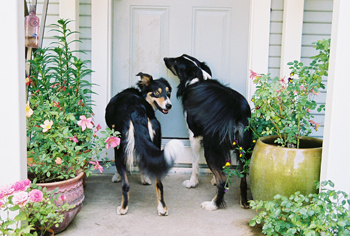
When my Border Collie Peaches died two years ago at the foot of my bed I went into the garden and strung marigolds on a thin red cord and then wrapped them lovingly and gently around her beautiful black and white neck, which made me weep the more, but she wholly deserved the honor. A kindly friend helped me carry her body into the back of my car and I drove, slowly, (deliriously) to a crematorium for animals, which, blessedly, Phoenix had. Once there I was determined to see her through to the very end. I pushed past my horrific fears and pain and asked to see what would transpire. They readily accommodated me, without question or hesitation. I was ushered quietly to the back of the small building. Outside on a cement patio stood a tall, stalwart Mexican gentleman who stood beside a simple oven. He opened the door and showed me the deep cavern which would later hold the body of my most precious dog. He told me in gentle and natural terms how he would put three dogs into the oven at a time. And the fires would purify their bodies as fire always does and render them into three piles of bones. Then these people lovingly and carefully put the three piles of bones into three buckets, each labeled. And the three buckets of bones were then carefully transferred into a machine one at a time that would pulverize the bones into a fine fine dust. They were very proud of this particular machine and told me how efficient it was, one of the best. I saw the result of some other person’s doggie’s bones, now a fine powdered grey dust. Dust to dust. All from a star. I’m sure you know. I steeled myself to my grief to allow myself to stay open to what was about to ensue. I had purchased a lovely enameled urn for my beloved Peaches’ powdered bones. They would return this to me at an agreed upon time.

I drove home in stunned silence, without my Peach by my side. She always rode in the passenger seat, accompanying me across country twice, and I don’t think I could have endured driving through the rural South without her. I know for a fact I could not. She was the most gentle BEST dog one could ever have wanted. So good. So conscious. So loving and loyal. And now she was gone.

As I returned over the path over which I’d arrived, I noticed a Unitarian Church on my right I’d not seen before, and I made a mental note to return. Indeed, on the very next Sunday I did return and found myself quite at home. Perhaps I’d found a church I could feel comfortable in? Alas, I felt a seering disappointment when the friendly minister took the pulpit and announced it was his last Sunday, that he was moving on. What am I doing here? His sermon began so:

“A woman had a dream. She dreamed she was walking her dear dog. But as she walked she suddenly realized that this dog had died. She looked around at the pastoral setting in what seemed to her to be a kind of heaven. Before her spread a vast meadow where the dog could run and be happy. And when the woman awoke from the dream she knew this dog was safe and well and would be there when she crossed over, awaiting her.”

I could scarcely contain myself. Tears streamed down my face and I immediately saw that Peaches’ death had required me to follow a specific path to take her to her final destination. That I would notice the church I’d never seen before. That I would arrive the very last day of this minister’s watch over this church. And his message was that my Peaches was fine. Was watching. Was waiting.

This kind of experience one has to stay tuned for. Must be ready to receive.
Must be open to receive. These are the blessings that surround us daily. They are found in the garden, and in every moment of our lives.

marigold bar

How Does Your Garden Grow?

Mary, Mary, quite contrary
How does your garden grow?
With silver bells and cockle shells
And pretty maids all in a row

–Old English nursery rhyme

I would be lying to you all if I let you think for a minute that my garden was all orderly, planned and laid out in neat rows. Not at all. I leave that for folks like my good friend Marsha who is so good at that sort of thing. You know. Raised beds. Compost. The lettuce with the lettuces. And tomatoes in her hothouse (which she and her husband built themselves). You know people like Marsha. You might be one yourself. She once cut willow branches and tucked them in the earth in arches and they sprouted into a lovely fence.

I am not like that at all.

No. My vege garden is a hodgepodge of experimentation. It is patchworked and random and, well, interesting. Oh, I suppose I had some kind of master plan. The flowers are with the flowers (mostly). And the greens do face up to other greens, eventually. But I must confess to hollyhocks bolting among the arugula,
all red and pink volunteers, and who am I to interfere? So in the Flower Row
you will find tall pastel snapdragons; a single magenta cloverlike creation, and a sole marigold that caught my eye at a Farmer’s Market one late morning; and many many, oh so many pansies and violas, which I religiously deadheaded all summer long, and you know how much work that is, don’t you? And hiding within the pansies is a green painted goddess of the moon, a Mexican ceramic creation of which I am fond. She’s quite content to live among the flowers and be watered all the time.

And then a row (oh, I do have proper rows) of tomatoes: five kinds, with basil sandwiched in between. That sounds good, does it not? And then it really honestly deteriorates into kind of a hilly area where four kind of lettuces, two kinds of chard and arugula abound. So much arugula I will never run out, oh lucky me. It’s my greatest vegetable pleasure. And I would be remiss if I did not mention that in the midst of the thickest and tallest growth of arugula has emerged a rose. Volunteer roses I find so unusual. Who would pull one up? So I gingerly skirt its thorns as I harvest my favorite sandwich green, occasionally forgeting and emerging with a scratch or two, but always ultimately deferring.

Then ’round the edges I thought to stick nasturtium seeds, remembering they are good “companion plants”, so those are bordering two sides of the garden,
clambering up what was orginally “puppy fencing”, meant to keep puppies in, and now keeping them out; and the morning glories make the third side (entwined in tomato vines, and neither minds at all). So it’s a happy affair all around.

And the piece de resistance is (ta da) a very large round red clay bowl that holds all my herbs. This foot-deep container lives in the corner of my garden closest to the back steps (see? planning!), so fresh lively parsley, thyme, oregano and cilantro are always readily available. The rosemary lives further away, at the far end of the garden, beyond the enclosing fence, at the end of a long row of California poppies. A reluctant, and yet-to-bloom volunteer hollyhock sidled up to it all summer long, threatening to overshadow it, but we negotiated the space with some sheers, and it didn’t much care.

Pondering, I’d have to think there is some part of me that leans toward obscurity, that there is some safety in not having clean edges where everything is so obvious and orderly. No. I prefer the eclecticism of the unexpected, the random here and there, capturing my imagination. Perhaps this unstructured arrangement also panders to my deep sense of wonder and discovery and to my love of hidden treasures. I’d say likely so. Whatever, the garden remains a constant state of discovery, of creation, a palette that continually changes, not just year to year, but season to season, garden to garden. Within my rich treasure trove of memory the experience compounds beyond what any casual observer might claim to see, for my vision exceeds the obvious and includes the notation that the California poppy row was last year’s tomato row; that this year’s tomato row was last year’s sunflower row; that the arugula now lives in the home of the previous year’s pumpkin row, which is ridiculous in itself because everyone knows a pumpkin doesn’t ever confine itself to any row. And so the experience deepens with each season and the mirror image of that life experience takes root within the life and heart of the gardener, not just the garden. And what has heart and meaning equals joy.

Next Year in the Garden–Famous Last Words

[Kathryn’s note: This summer I had the pleasure of meeting editor/publisher Stephen Morris at SolFest, put on by the Solar Living Center, where Stephen was presenting. SolFest is an annual event dedicated to renewable energy and sustainable living. Stephen is the first guest blogger for Plant Whatever Brings You Joy!]

Famous Last Words

by Stephen Morris

Part I–Spring

Next year in the garden I won’t plant my seeds too early just because I am excited by a warm day in April. I will wear a long sleeve shirt while pruning roses, raspberries, and blackberries. I will open seed packets the right way so that they reseal. I won’t just rip off the tops, then wonder why my pockets are filled with spilled seed.

Next year in the garden I will read the instructions before planting the seeds. That is, I will read the instructions IF I remember my reading glasses. Gardening is yet one more activity that now requires those damn things.

Next year in the garden I won’t read the newspapers as I lay down the mulch, and I will take off my muddy boots before coming into the kitchen.

I won’t shout “Ignition!” when I see the first green dots of germination. I won’t pump my fist and say “Yes!” when green shoots of garlic poke through the hay. I will take it in stride, with the right stuff of a master gardener.

Next year in the garden I will keep detailed records of what I do, when, and where. I won’t mark planted rows with little sticks and kid myself that I will remember what I planted.

And I won’t plant too many zucchini, or too few. I promise.

Part II–Summer

Next year in the garden I won’t wander out after showering and changing clothes to admire my work and bend down to pluck just one errant weed, because I’ve learned that one good weed deserves another.

I won’t work with my shirt off, even though it feels so good, because I know the sun is bad for me. I will always put on sun screen (SPF 45 and wear a wide-brimmed hat).

I will make myself smile by singing “Inch by inch, row by row…”, and not once will I think about the Dow Jones Industrial Average. I will, however, wonder who the Red Sox will use as a fifth starter and marvel at the ability of David Ortiz to deliver in the clutch.

Next year in the garden I will do successive plantings so that I always have tender lettuce. I won’t say “What the heck,” and empty the rest of the packet.

I won’t plant peas in August that don’t have a prayer of bearing fruit before the frost. Next year in the garden I won’t curse potato bugs, but will accept my responsibility for the pests I attract. I will outwit potato bugs by not planting potatoes. Next year, that is.

I will de-sucker the tomatoes religiously, and I will build those groovy bent-wood trellises I saw in the gardening magazine. I will say a prayer when I eat the first red fruit.

I won’t let the rogue squash grow, thinking it might turn out to be the elusive “great pumpkin.”

Next year in the garden, at least once, I will strip off all my clothes, lie spread-eagled in the dirt and say “Take me, God, I’m yours!” Then I will take an outdoor shower, scrubbing every nook and cranny, and feel like the luckiest man on the face of the earth.

Part III–Fall

Next year in the garden, as I pull weeds, I won’t think that I coined the phrase “Nature abhors a vacuum.” (Who did coin that phrase, if not me?).

I won’t wonder why I planted mustard greens.

I will wear a long-sleeve shirt while pruning the roses. Did I already say that?

I won’t start the chipper-shredder “just to see if it will start,” then put through a sunflower stalk “just to see what happens,” especially when I am just killing time before we go out to dinner.

Next year I won’t bore visitors with extensive garden tours, filled with eloquent soliloquies on the virtues of compost. I won’t describe myself as the “poor man’s Eliot Coleman.”

I will pick the chard before it becomes tough and stringy.

Sunflower, cropped

I won’t stand speechless before a ten foot sunflower and marvel at the memory of pressing a single seed into the soil with my thumb. I won’t laugh out loud when I see three blue jays hanging upside down on the foot-wide seed pods, possessed by gluttony.

I won’t be disappointed when the Sox fall by the wayside, because I know there is always next year.

Next year in the garden, I will cover at the hint of frost.

I will plant my bulbs and garlic before the ground freezes, but I won’t cover them with mulch until the ground is hard and critter-proof.

I won’t pretend not to be disappointed when my garlic and cherry tomatoes fail to score ribbons at the Tunbridge World’s Fair.

Next year in the garden I won’t break into Joni Mitchell’s “Urge for Going” when I see a chevron overhead.

Part IV–Winter

Next year in the garden I won’t get delusional when I see this year’s seeds on sale. I won’t buy enough to feed all of central Vermont and I won’t think I’m a rich man as I flip through the colorful packets in January. I won’t question why I bought two types of turnips. I hate turnips.

I won’t delude myself into thinking I can grow seven varieties of pepper from seed.
I won’t buy seeds for inedible greens with exotic Japanese names.
I will store my squash properly, so they don’t rot.
I will give gifts of garlic and elderberry wine as if I am bestowing frankincense and myhrr (even though the elderberry wine sucks).
I won’t take it personally when I see how cheap garlic is at Costco.
I won’t check the mail for the first seed catalog the day after Christmas.
I will think good thoughts when we eat last summer’s pesto.

Next year in the garden I won’t think I am part of life’s great cycle just because I pee on the frozen compost.

Excerpted from The New Village Green (New Society Publishers, 2007). Stephen Morris is the editor and publisher of Green Living: A Practical Journal for Friends of the Environment.

© 2008 - 2026 Kathryn Hall. All rights reserved.
For optimal viewing Mac users using IE should access via Safari.
Pixel Surgery by Site Mechanix