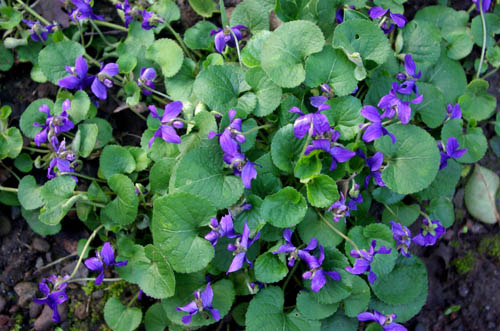
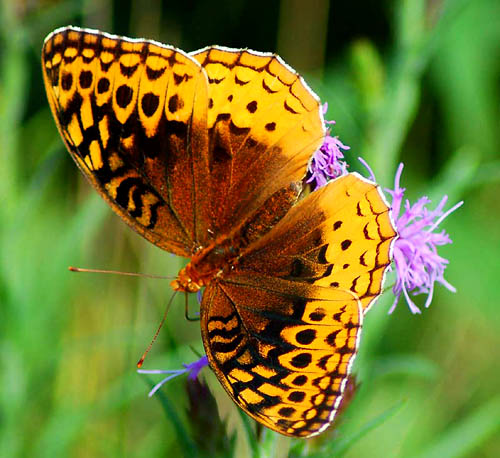
In winter the gardener’s eye is scanning the landscape for anything and everything that will fill our enormous desire for the beauty to which we are treated all summer. And thus one is inclined to see what might otherwise have been lost in the splendor of roses and hydrangea, of trumpet vine and forsythia. Attention now focuses here on the lowly wild violet. I cherish this time of year as there is a large section of the front lawn that bursts with these tiny purple treasures and I delight in their beauty, fortitude, and resilience. But until this week I have to admit to having taken them for granted. Indeed, the only moment they really had placed themselves squarely on my inner radar was when I was researching butterfly habitat last summer, and made a mental note that the wild violet was hospitable to the eggs of the fritillary butterfly. I was glad to make note of their pragmatic presence.
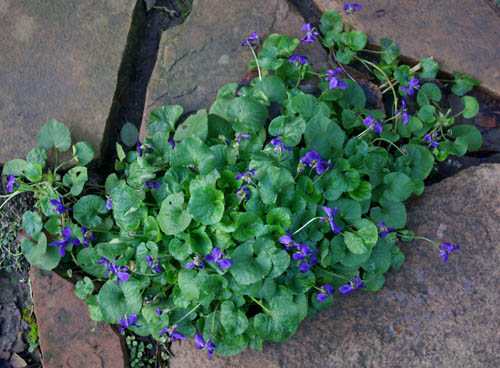
In the many years I have been on this property I have let the violets spread where they will. I actually welcomed them into the crevices between the flagstone pavers I’d put down in front of the rose arbor. I thanked them, and they obligingly spread about.
Charmingly, they kept a pinkish lavender violet company which I’d purchased at a local nursery.
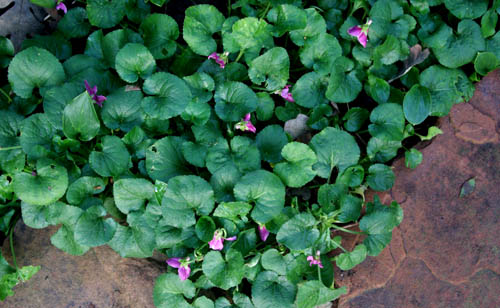
How did one end up in a pot for which I paid money, and one become part of the natural landscape? You tell me! Of course I assume the pink one is a hybrid. But the wild violet? How did it end up here? I have no idea. I know it’s tenacious. That answers many questions.
When I began to research the wild violet I was shocked and appalled and saddened to see how many references were regarding how to get rid of it. How to Remove Wild Violets from Your Lawn. Enter poisons, though even poisons apparently are not that effective. More aggressive than even I anticipated. But so not where I wanted to go with this post. My intention is to praise its beauty and express my gratitude that it has chosen to live here and delight my senses. And be a host to the lovely fritillary butterfly. Yes, I like that much better. Thank you.
For violets suit when home birds build and sing,
Not when the outbound bird a passage cleaves;
Not with dry stubble of mown harvest sheaves,
But when the green world buds to blossoming.~Christina Georgina Rossetti
Probably one reason violets so appeal to me is that I am completely enchanted by small bouquets. Violets lend themselves perfectly to this passion of mine.
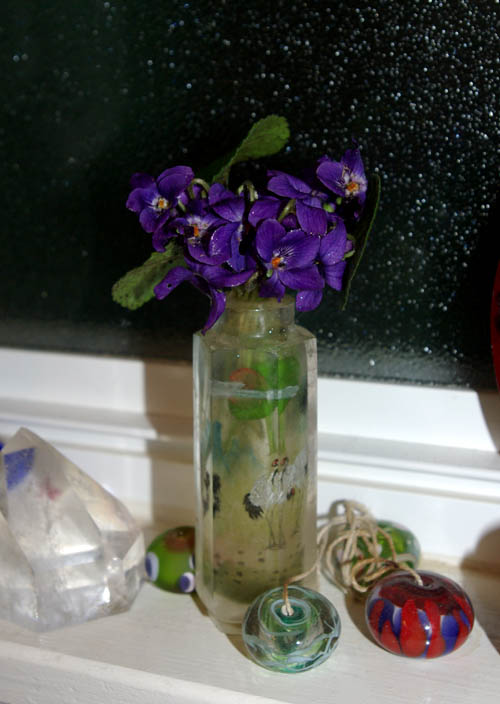
How very dear, indeed.
Love and winter gardening blessings,
Kathryn xoxoo
Footnote: Many thanks to Pomona Belvedere for teaching me this wild violet is formally known as viola odorata. Very helpful!
Posted on January 26th, 2010 by Kathryn
Filed under: Plants









I’ve always loved them and encourage them here, too. So so sweet!
How perfectly Lovely! They look so pretty in the spaces between the flagstone pavers! Beautiful pictures, too!
Love you,
Antonia
xoxox
Good morning, Kylee! I’m so glad you, too, are a fan! Yes, so sweet.
Kathryn xoxo
Hi, Antonia! Yes, they are particularly pretty popping up between the pavers! All on their own! Love, Mom xoxo
I have wonderful violets that hug the walls of my square foot garden. They are little gifts of nature that just appeared over time.
Hi, Nancy! Welcome! Hugging the walls sounds so endearing. They are a blessing, for sure.
Thanks for the visit! Love, Kathryn xoxo
Hi Kathryn!
I loved this post. I had to look this up, but as you show here, Violets in the past were not something to poison, but a kind of muse to the poet!
A Violet by a mossy stone
Half hidden from the eye!
Fair as a star when only one
Is shining in the sky
Wordsworth, “She Dwelt Among the Untrodden Ways”
Thanks for taking us back to this place!

Philip
Kathryn: Violets and the Viola family are an important group of plants. My Field Book of American Wild Flowers list 18 distinct named species. My Peterson Field Guide breaks them down by color (9 white, 6 yellow, 3 violet, 24 violet-blue) They grow in meadows and in deep woods, in dryer areas and along flood plains, They range in color from deepest dark purple to white and every red and blue (and gray) toning of purple in between. They can be striped, freckled, and wonderful yellow. They can be determinant (leaves and flower stalks all at the root) or indeterminant (leaves and flowers shooting out along a growing stem). Here in central Ohio, I have dark purple, blue-purple, and red-purple that are determinant, also a white one with a gray-light purple face that came from PA as a gift and is now all over. Also a field pansey in white that is indeterminant. Apparently, that one is not native, but it fills in over the high maple tree roots in the front so we just let it grow as ground cover. They are an important part of our “ground cover” selections for areas where grass is either unwanted and/or impossible to grow and/or maintain. We love them.
Also remember that we let them grow all over Walnut Grove Cemetery. I think you wrote about that several years ago.
Hugs, Julie
Hi, Philip! Wow! Thanks so much for the Wordsworth poem! I do remember those lines! Yes, oh why, oh why would we not continue to love and protect the beautiful little violet? It comes unbidden, free and giving! I hope you have them in your garden.
Kathryn xoxo
Oh, Julie, you have outdone yourself on generosity, to look all that up for us and pass along. Thank you!
I did not recall that violets were one of the flowers you are cultivating in the Walnut Grove Cemetery, but it makes good sense. And you’ve confirmed for me that this would be an excellent solution for that patch of ground in my garden that gets too much water and too much shade (and too many Border Collies passing through) for grass to grow. So why not violets?? I have one white violet out front. It’s the only one. I haven’t seen all those other colors. I must pay closer attention how to cultivate these precious plants! I do collect viola seeds, so….Love, Kathryn xoxo
Kathryn,
I enjoyed reading your lovely facts and musings as well as seeing the wonderful photos. As a very young child in the western mountains of Virginia, I picked blue, pink and white violets from our lawn for my mother. Now, in Vermont, I have been pleasantly surprised by the violets which have volunteered in our back lawn and in my flower gardens. Thank you, Susan
Welcome, Susan. I just added WSLF to my blogroll. Thank you. I love the thought of your picking white, pink and blue violets for your mother as a child. What a precious memory! Thank you for sharing. May children who follow do same. Kathryn xoxo
I love wild violets and seem to spend an inordinate amount of time digging them up out of the lawn and planting them ’safely’ elsewhere to prevent them getting killed off by the treatmnet to sort the moss lawn out!
Hi, Liz! How wonderful to know someone is trying to rescue them, not wipe them out! I’d think they’d do well in the UK, as moisture seems to be one of their preferences. I don’t suppose you’d let them just win and have a lawn of violets?? (Does anyone reading this blog have a lawn of pure violets?? Let’s start a trend!)
Kathryn xoxoo
I’m a big fan of all sweet violets and I’m crazy about the scent. I sowed some in my garden and now they’re popping up here and there–a lovely surprise. My parma violets seem to have taken a hit this past year, however. I’m not sure if any of them will bloom. Boo-hoo!
Hi, Claire! Now I’m curious about the differences between the ones we plant and the ones that plant themselves! I must dig in to this more! Thanks! Kathryn xoxo
We are always happy to see our wild violets. What a boon to learn about the butterfly habitat aspect. Thank you!
I enjoyed this celebration of violets and didn’t know they attracted the fritillary butterfly, just another added attraction for this excellent and often-overlooked flower. While violets are in disrepute now, they were the hot corsage flower in the early 1900s, through the 20s and were widely grown in greenhouses and out of them. It might be that some of those varieties in Julie’s area are escapees from cultivated violet stock. Or it might not. I have planted some of the cultivated varieties but wind up liking the wild V. odorata, in violet, the best.
Good morning, Daffodil Planter! Welcome. I am so impressed that nearly everyone who has left comments, regardless of where they live, can boast of having wild violets in their gardens. It’s heartening. Hopefully this little post will give them some good pr. They are clearly beloved. Thanks! Kathryn xoxo
Pomona Belvedere! What a Godsend you are to tell us so much about wild violets. Thank you so much!
Wild V. odorata it is! Thanks again. Kathryn xoxo
Yes, I do believe they were very popular at one time. You see them on old fashioned cards in the loveliest of contexts. And as Philip has pointed out they were the muse of poets. WHO decided they were to be wiped out? So sad. Let’s bring them back. Invitation here to take it upon ourselves to point out their beauty at every opportunity. Pact.
I love our wild violets too. I can never understand gardeners who kill wildflowers. Thanks for bringing a sweet reminder of summer to our long winter. I have forced narcissus blooming in my kitchen only.
Hi, Sarah, So glad to hear you have them, too. They are incredibly widespread and I wish I could tap into their memory bank and follow their journey from Europe and Asia through the hearts of (probably) women who thought to bring them to America and the lower large islands. Forced narcissus sounds fun. I will try! Thanks for the visit. Kathryn xoxo
Honoring violets, February flower of the month … quite lovely, dear Kathryn. I have a similar photo posted of violets (poking through patio cracks) in the snow. But I must admit to having a love/hate relationship with these cuties. I love them candied, adorning desserts and tossed in spring salads but throughout the rest of the year (I’m afraid to share)!
Good morning, Joey! It sounds as if you’ve found a lovely use for them and they are serving you well! Love, Kathryn xoxo
I love your post about violets. When I was a little girl, they were my favorite flowers. They grew wild in our backyard in the hills of Fairfax. I had a tiny little doll that fit in the palm of my hand and I used to play with her among violets, pretending the delicate flowers and greenery were a mini-dollhouse of sorts.
Hi, Kathlene! I LOVE this story! I can picture the whole thing! It speaks to the imagination of the child, and the beauty that is Marin. Lovely lovely image. So sweet. Thank you for sharing. Love, Kathryn xoxo
I’m glad to see you write this. Although some think of the humble violet as pest, I haven’t found them so. In fact, if I don’t want them in a particular place, I pull them up. Love them when it’s chilly and nothing else is much blooming.~~Dee
Hi, Dee! I do think they need to comeback. I’m quite sure they were interfering with someone’s pocketbook and got some bad press. Afterall, we don’t want an uninvited guest in our gardens, do we? It must be a WEED!
How could something beautiful just show up unbidden??
For free! Glad you are a fan. Me, too. Kathryn xoxo
I have recently discovered these wonderful little plants, and as a lover of all things living, I feel as if I have discovered a gem! There are several bunches in the field behind my home that I intend to transplant into my yard. I think they will be beautiful around a tree – near my butterfly bushes! My husband and I recently noticed that most of the plants we are enjoying now (early spring in NC) are plants that were given to us from others’ gardens. Volunteering perrenials are the best!! I love your site and appreciate hearing from others who want to protect, not destroy, our natural flora. God bless you all!
Hi, Dee and welcome! Lovely comment.
I did exactly the same thing–transplanted a bunch underneath my butterfly bush! Try it! You will be so pleased! Kathryn xoox
when i grew up, we had fields of wild violets. i have tried to find violets like these to purchase, but have not had any luck.
any idea how i might get some plants?
Hi, jane monk, and welcome. I’m sorry. I haven’t a clue. But I am thinking these truly are a wild flower and unlikely to be found in a shop. Please note, as mentioned, what you will find are poisons to get rid of them. I’m afraid fans are going to need to find the wild variety and transplant. Good luck! Sounds like a fun task!
Kathryn xoox
I live in upstate New York, and the house that i just moved into in February has a side yard and part of the back full of violets. I am thrilled. I have made things from them as well, such as salads, vinegars and syrups. I am now wondering if I were cut the area they are in with the lawn mower if it would be detrimental to them. So far I am mowing around them, and allowing the space they occupy to grow very tall, and a few buttercups have sprouted along with some very beautiful little purple flower ground cover. My gut is telling me that a mowing or two won’t hurt them but may help. Not sure. If anyone is please post!! Loving all these violets and her friends.
Hi, Andrea! Welcome! I think your gut is telling you the right thing. I mow the ones in the front of the house, as they grow in and among grasses that will grow too tall otherwise, and they always come back. How lucky to have buttercups, too! Enjoy! Kathryn xoxo